

Progress and perspectives on hydrogel-assisted skin organoids

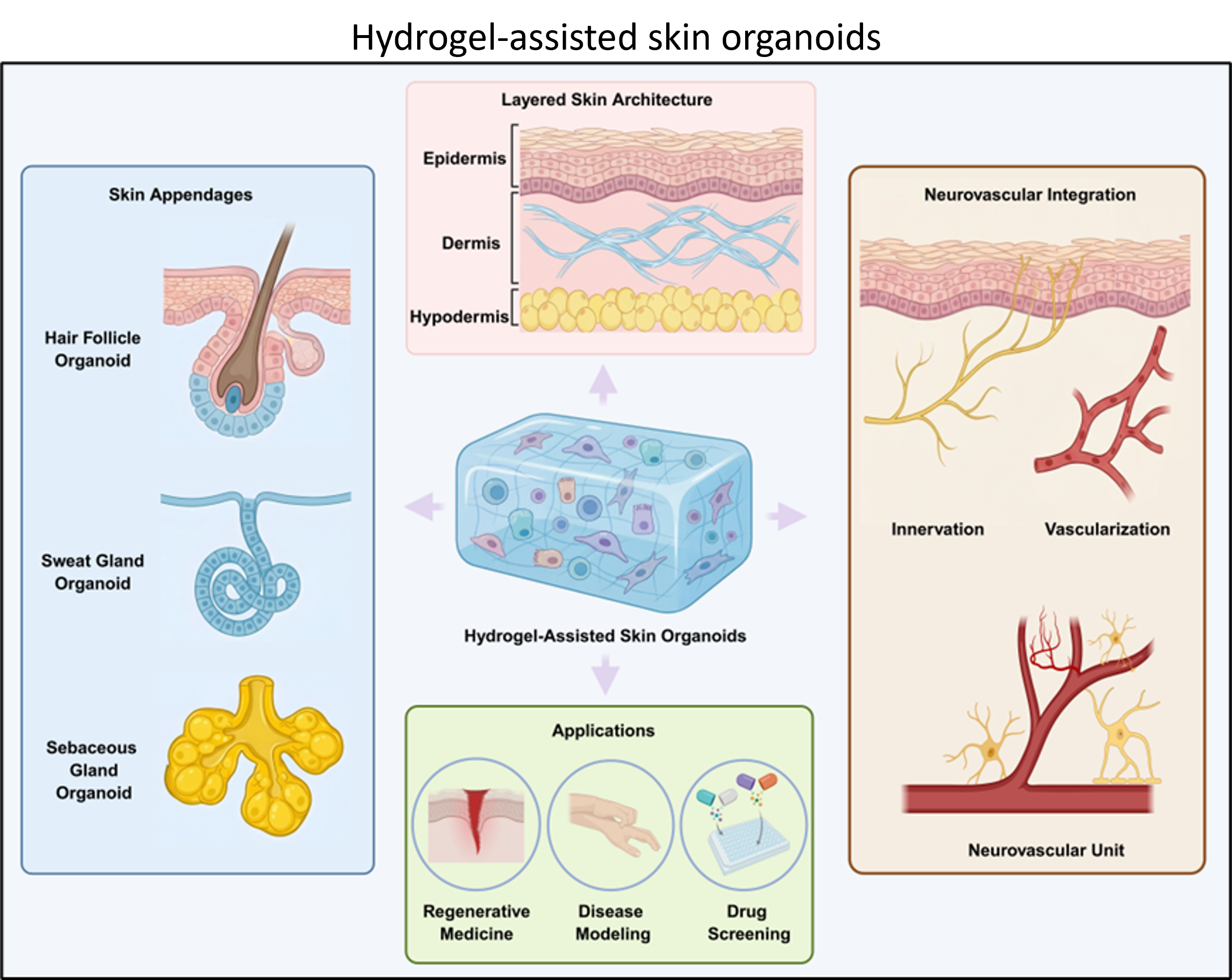
Skin organoids offer a powerful in vitro platform for modeling human skin physiology, disease mechanisms, and regenerative processes. However, faithfully recapitulating the multilayered architecture of skin, diverse appendages, and integrated vascular– neural networks remains a major challenge. As key extracellular matrix mimetics, hydrogels have emerged as central enablers in advancing skin organoid engineering by complementing passive self-organization with programmable biofabrication strategies. This review summarizes recent progress in hydrogel-assisted skin organoid engineering, highlighting how these systems enable the reconstruction of layered skin architectures, support the morphogenesis of skin appendages, and facilitate the integration of vascular and neural components, thereby progressively improving the structural and functional fidelity of skin organoids. These developments position hydrogel-based platforms as essential tools for advancing next-generation skin organoid models. By enabling more precise control over the microenvironment and tissue organization, hydrogel-assisted strategies are expected to accelerate the development of physiologically relevant skin organoids and expand their applications in regenerative medicine, drug discovery, and the study of complex skin disorders.
- Gravitz L. Skin. Nature. 2018;563(7732):S83-S83. doi: 10.1038/d41586-018-07428-4
- Arda O, Göksügür N, Tüzün Y. Basic histological structure and functions of facial skin. Clin Dermatol. 2014;32(1):3-13. doi: 10.1016/j.clindermatol.2013.05.021
- Takeo M, Lee W, Ito M. Wound healing and skin regeneration. Cold Spring Harb Perspect Med. 2015;5(1):a023267. doi: 10.1101/cshperspect.a023267
- Nicolaou A, Kendall AC. Bioactive lipids in the skin barrier mediate its functionality in health and disease. Pharmacol Ther. 2024;260:108681. doi: 10.1016/j.pharmthera.2024.108681
- Li W, Liang Y, Tan X, et al. Self-powered microneedle patch with synergistic mild microwave thermal therapy for scarless healing of infected diabetic wound. ACS Appl Mater Interfaces. 2025;17(46):62936-62956. doi: 10.1021/acsami.5c14924
- Ullah S, Mansoor S, Ayub A, et al. An update on stem cells applications in burn wound healing. Tissue Cell. 2021;72:101527. doi: 10.1016/j.tice.2021.101527
- Jacobi U, Kaiser M, Toll R, et al. Porcine ear skin: an in vitro model for human skin. Skin Res Technol. 2007;13(1):19-24. doi: 10.1111/j.1600-0846.2006.00179.x
- Bartek MJ, LaBudde JA, Maibach HI. Skin permeability in vivo: comparison in rat, rabbit, pig and man. J Invest Dermatol. 1972;58(3):114-123. doi: 10.1111/1523-1747.ep12538909
- Schmook FP, Meingassner JG, Billich A. Comparison of human skin or epidermis models with human and animal skin in in-vitro percutaneous absorption. Int J Pharm. 2001;215(1-2):51-56. doi: 10.1016/s0378-5173(00)00665-7
- Yan HHN, Chan AS, Lai FP, Leung SY. Organoid cultures for cancer modeling. Cell Stem Cell. 2023;30(7):917-937. doi: 10.1016/j.stem.2023.05.012
- Ali M, Pr AK, Yoo JJ, Zahran F, Atala A, Lee SJ. A photo-crosslinkable kidney ECM-derived bioink accelerates renal tissue formation. Adv Healthc Mater. 2019;8(7):e1800992. doi: 10.1002/adhm.201800992
- Hu N, Shi JX, Chen C, et al. Constructing organoid-brain-computer interfaces for neurofunctional repair after brain injury. Nat Commun. 2024;15(1):9580. doi: 10.1038/s41467-024-53858-2
- Klotz BJ, Oosterhoff LA, Utomo L, et al. A versatile biosynthetic hydrogel platform for engineering of tissue analogues. Adv Healthc Mater. 2019;8(19):e1900979. doi: 10.1002/adhm.201900979
- Sato T, Vries RG, Snippert HJ, et al. Single Lgr5 stem cells build crypt-villus structures in vitro without a mesenchymal niche. Nature. 2009;459(7244):262-265. doi: 10.1038/nature07935
- Shafiee A, Sun J, Ahmed IA, et al. Development of physiologically relevant skin organoids from human induced pluripotent stem cells. Small. 2024;20(16):e2304879. doi: 10.1002/smll.202304879
- Ebner-Peking P, Krisch L, Wolf M, et al. Self-assembly of differentiated progenitor cells facilitates spheroid human skin organoid formation and planar skin regeneration. Theranostics. 2021;11(17):8430-8447. doi: 10.7150/thno.59661
- Lee J, Sutani A, Kaneko R, et al. In vitro generation of functional murine heart organoids via FGF4 and extracellular matrix. Nat Commun. 2020;11(1):4283. doi: 10.1038/s41467-020-18031-5
- Lei M, Jiang J, Wang M, et al. Epidermal-dermal coupled spheroids are important for tissue pattern regeneration in reconstituted skin explant cultures. NPJ Regen Med. 2023;8(1):65. doi: 10.1038/s41536-023-00340-0
- Weng T, Wu P, Zhang W, et al. Regeneration of skin appendages and nerves: current status and further challenges. J Transl Med. 2020;18(1):53. doi: 10.1186/s12967-020-02248-5
- Chen L, Xing Q, Zhai Q, et al. Pre-vascularization enhances therapeutic effects of human mesenchymal stem cell sheets in full thickness skin wound repair. Theranostics. 2017;7(1):117- 131. doi: 10.7150/thno.17031
- Frantz C, Stewart KM, Weaver VM. The extracellular matrix at a glance. J Cell Sci. 2010;123(24):4195-4200. doi: 10.1242/jcs.023820
- Caliari SR, Burdick JA. A practical guide to hydrogels for cell culture. Nat Methods. 2016;13(5):405-414. doi: 10.1038/nmeth.3839
- Guvendiren M, Burdick JA. Engineering synthetic hydrogel microenvironments to instruct stem cells. Curr Opin Biotechnol. 2013;24(5):841-846. doi: 10.1016/j.copbio.2013.03.009
- Chen X, Feng Y, Zhang P, Ni Z, Xue Y, Liu J. Hydrogel fibers-based biointerfacing. Adv Mater. 2025;37(4):e2413476. doi: 10.1002/adma.202413476
- Weng T, Zhang W, Xia Y, et al. 3D bioprinting for skin tissue engineering: current status and perspectives. J Tissue Eng. 2021;12:20417314211028574. doi: 10.1177/20417314211028574
- Cubo N, Garcia M, del Cañizo JF, Velasco D, Jorcano JL. 3D bioprinting of functional human skin: production and in vivo analysis. Biofabrication. 2016;9(1):015006. doi: 10.1088/1758-5090/9/1/015006
- Ganguly S, Wulff D, Phan CM, Jones LW, Tang XS. Injectable and 3D extrusion printable hydrophilic silicone-based hydrogels for controlled ocular delivery of ophthalmic drugs. ACS Appl Bio Mater. 2024;7(9):6286-6296. doi: 10.1021/acsabm.4c00901
- Griffin DR, Weaver WM, Scumpia PO, Di Carlo D, Segura T. Accelerated wound healing by injectable microporous gel scaffolds assembled from annealed building blocks. Nat Mater. 2015;14(7):737-744. doi: 10.1038/nmat4294
- Gjorevski N, Sachs N, Manfrin A, et al. Designer matrices for intestinal stem cell and organoid culture. Nature. 2016;539(7630):560-564. doi: 10.1038/nature20168
- Viswanathan P, Guvendiren M, Chua W, et al. Mimicking the topography of the epidermal–dermal interface with elastomer substrates. Integr Biol. 2016;8(1):21-29. doi: 10.1039/c5ib00238a
- Trappmann B, Gautrot JE, Connelly JT, et al. Extracellular-matrix tethering regulates stem-cell fate. Nat Mater. 2012;11(7):642-649. doi: 10.1038/nmat3339
- Wisdom EC, Aduba DC, Lewis O, et al. A novel approach to pattern dermal papilla spheroids in dermal–epidermal composites using non-adherent microwell arrays. Bioengineering. 2025;12(12):1281. doi: 10.3390/bioengineering12121281
- Song W, Yao B, Zhu D, et al. 3D-bioprinted microenvironments for sweat gland regeneration. Burns Trauma. 2022;10:tkab044. doi: 10.1093/burnst/tkab044
- Huang S, Yao B, Xie J, Fu X. 3D bioprinted extracellular matrix mimics facilitate directed differentiation of epithelial progenitors for sweat gland regeneration. Acta Biomater. 2016;32:170-177. doi: 10.1016/j.actbio.2015.12.039
- Bertassoni LE, Cecconi M, Manoharan V, et al. Hydrogel bioprinted microchannel networks for vascularization of tissue engineering constructs. Lab Chip. 2014;14(13):2202- 2211. doi: 10.1039/c4lc00030g
- Bellantoni D, Casale C, Mazio C, Urciuolo F, Imparato G, Netti PA. Development of an innervated human skin equivalent to model nociceptive circuitry in vitro. Biomaterials. 2026;328:123808. doi: 10.1016/j.biomaterials.2025.123808
- Das P, Ganguly S, Saravanan A, et al. Naturally derived carbon dots in situ confined self-healing and breathable hydrogel monolith for anomalous diffusion-driven phytomedicine release. ACS Appl Bio Mater. 2022;5(12):5617-5633. doi: 10.1021/acsabm.2c00664
- Morasso MI, Tomic‐Canic M. Epidermal stem cells: the cradle of epidermal determination, differentiation and wound healing. Biol Cell. 2012;97(3):173-183. doi: 10.1042/bc20040098
- Frankart A, Malaisse J, De Vuyst E, Minner F, de Rouvroit CL, Poumay Y. Epidermal morphogenesis during progressive in vitro 3D reconstruction at the air–liquid interface. Exp Dermatol. 2012;21(11):871-875. doi: 10.1111/exd.12020
- Wang X, Wang S, Guo B, et al. Human primary epidermal organoids enable modeling of dermatophyte infections. Cell Death Dis. 2021;12(1):35. doi: 10.1038/s41419-020-03330-y
- Kwak S, Song CL, Lee J, et al. Development of pluripotent stem cell-derived epidermal organoids that generate effective extracellular vesicles in skin regeneration. Biomaterials. 2024;307:122522. doi: 10.1016/j.biomaterials.2024.122522
- Kaur S, Kaur I, Rawal P, Tripathi DM, Vasudevan A. Non-matrigel scaffolds for organoid cultures. Cancer Lett. 2021;504:58-66. doi: 10.1016/j.canlet.2021.01.025
- Zeng D, Li S, Du F, et al. Advances in engineered organoid models of skin for biomedical research. Burns Trauma. 2025;13:tkaf016. doi: 10.1093/burnst/tkaf016
- Hong ZX, Zhu ST, Li H, et al. Bioengineered skin organoids: from development to applications. Mil Med Res. 2023;10(1):40. doi: 10.1186/s40779-023-00475-7
- Woodley DT. Distinct fibroblasts in the papillary and reticular dermis: implications for wound healing. Dermatol Clin. 2017;35(1):95-100. doi: 10.1016/j.det.2016.07.004
- Zhou M, Ulijn RV, Gough JE. Extracellular matrix formation in self-assembled minimalistic bioactive hydrogels based on aromatic peptide amphiphiles. J Tissue Eng. 2014;5:2041731414531593. doi: 10.1177/2041731414531593
- Guo Y, Bian Z, Xu Q, et al. Novel tissue-engineered skin equivalent from recombinant human collagen hydrogel and fibroblasts facilitated full-thickness skin defect repair in a mouse model. Mater Sci Eng C Mater Biol Appl. 2021;130:112469. doi: 10.1016/j.msec.2021.112469
- R. Ibañez RI, do Amaral RJFC, Reis RL, Marques AP, Murphy CM, O’Brien FJ. 3D-printed gelatin methacrylate scaffolds with controlled architecture and stiffness modulate the fibroblast phenotype towards dermal regeneration. Polymers (Basel). 2021;13(15):2510. doi: 10.3390/polym13152510
- Fuchs E. Epithelial Skin Biology. In: Essays on Developmental Biology, Part A (Current Topics in Developmental Biology). Elsevier; 2016:357-374. doi: 10.1016/bs.ctdb.2015.11.033
- Baker P, Huang C, Radi R, Moll SB, Jules E, Arbiser JL. Skin barrier function: the interplay of physical, chemical, and immunologic properties. Cells. 2023;12(23):2745. doi: 10.3390/cells12232745
- Sun J, Ahmed I, Brown J, Khosrotehrani K, Shafiee A. The empowering influence of air-liquid interface culture on skin organoid hair follicle development. Burns Trauma. 2025;13:tkae070. doi: 10.1093/burnst/tkae070
- Jorgensen AM, Varkey M, Gorkun A, et al. Bioprinted skin recapitulates normal collagen remodeling in full-thickness wounds. Tissue Eng Part A. 2020;26(9-10):512-526. doi: 10.1089/ten.TEA.2019.0319
- Montero A, Quílez C, Valencia L, Girón P, Jorcano JL, Velasco D. Effect of fibrin concentration on the in vitro production of dermo-epidermal equivalents. Int J Mol Sci. 2021;22(13):6746. doi: 10.3390/ijms22136746
- Li X, Wang C, Xiong Q, et al. A photocurable and thermocurable composite hydrogel and the application in a contraction resistant full-thickness skin model. Biofabrication. 2024;17(1):015043. doi: 10.1088/1758-5090/ad905e
- Bacakova M, Pajorova J, Broz A, et al. A two-layer skin construct consisting of a collagen hydrogel reinforced by a fibrin-coated polylactide nanofibrous membrane. Int J Nanomedicine. 2019;14:5033-5050. doi: 10.2147/ijn.S200782
- Blackstone BN, Malara MM, Baumann ME, McFarland KL, Supp DM, Powell HM. Fractional CO(2) laser micropatterning of cell-seeded electrospun collagen scaffolds enables rete ridge formation in 3D engineered skin. Acta Biomater. 2020;102:287-297. doi: 10.1016/j.actbio.2019.11.051
- Roig-Rosello E, Rousselle P. The human epidermal basement membrane: a shaped and cell instructive platform that aging slowly alters. Biomolecules. 2020;10(12):1607. doi: 10.3390/biom10121607
- Shen Z, Cao Y, Li M, et al. Construction of tissue-engineered skin with rete ridges using co-network hydrogels of gelatin methacrylated and poly(ethylene glycol) diacrylate. Mater Sci Eng C Mater Biol Appl. 2021;129:112360. doi: 10.1016/j.msec.2021.112360
- Shen Z, Liu Z, Sun L, et al. Constructing epidermal rete ridges using a composite hydrogel to enhance multiple signaling pathways for the maintenance of epidermal stem cell niche. Acta Biomater. 2023;169:273-288. doi: 10.1016/j.actbio.2023.07.037
- Xie J, Yang Q, Zhang Y, Zheng K, Geng H, Wu Y. The bioengineering of microspheric skin organoids and their application in drug screening. Adv Sci (Weinh). 2025;12(22):e2416863. doi: 10.1002/advs.202416863
- Lee J, van der Valk WH, Serdy SA, et al. Generation and characterization of hair-bearing skin organoids from human pluripotent stem cells. Nat Protoc. 2022;17(5):1266-1305. doi: 10.1038/s41596-022-00681-y
- Wang M, Luo Y, Wang T, et al. Artificial skin perception. Adv Mater. 2021;33(19):e2003014. doi: 10.1002/adma.202003014
- Sutterby E, Thurgood P, Baratchi S, Khoshmanesh K, Pirogova E. Microfluidic skin-on-a-chip models: toward biomimetic artificial skin. Small. 2020;16(39):e2002515. doi: 10.1002/smll.202002515
- Cao X, Lu M, Li N, Cai L, Wang Y, Zhao Y. Emerging biomedical engineering strategies for hair follicle regeneration. Bioact Mater. 2025;53:84-113. doi: 10.1016/j.bioactmat.2025.06.051
- Zhu L, Yuhan J, Yu H, Zhang B, Huang K, Zhu L. Decellularized extracellular matrix for remodeling bioengineering organoid’s microenvironment. Small. 2023;19(25):e2207752. doi: 10.1002/smll.202207752
- Kageyama T, Miyata H, Seo J, Nanmo A, Fukuda J. In vitro hair follicle growth model for drug testing. Sci Rep. 2023;13(1):4847. doi: 10.1038/s41598-023-31842-y
- Abreu CM, Gasperini L, Lago MEL, Reis RL, Marques AP. Microscopy-guided laser ablation for the creation of complex skin models with folliculoid appendages. Bioeng Transl Med. 2021;6(2):e10195. doi: 10.1002/btm2.10195
- Gupta AC, Chawla S, Hegde A, et al. Establishment of an in vitro organoid model of dermal papilla of human hair follicle. J Cell Physiol. 2018;233(11):9015-9030. doi: 10.1002/jcp.26853
- Chen H, Ma X, Zhang M, Liu Z. Injectable and biofunctionalized fibrin hydrogels co-embedded with stem cells induce hair follicle genesis. Regen Biomater. 2023;10:rbac086. doi: 10.1093/rb/rbac086
- Lin BJ, Wang J, Miao Y, et al. Cytokine loaded layer-by-layer ultrathin matrices to deliver single dermal papilla cells for spot-by-spot hair follicle regeneration. J Mater Chem B. 2016;4(3):489-504. doi: 10.1039/c5tb02265g
- Sugiyama E, Nanmo A, Nie X, et al. Large-scale preparation of hair follicle germs using a microfluidic device. ACS Biomater Sci Eng. 2024;10(2):998-1005. doi: 10.1021/acsbiomaterials.3c01346
- Nanmo A, Yan L, Asaba T, Wan L, Kageyama T, Fukuda J. Bioprinting of hair follicle germs for hair regenerative medicine. Acta Biomater. 2023;165:50-59. doi: 10.1016/j.actbio.2022.06.021
- Zheng B, Yang L, Feng S, et al. Organoid-loaded cryomicroneedles for biomimic hair regeneration. Adv Funct Mater. 2024;34(3):2304950. doi: 10.1002/adfm.202304950
- Liu Y, Gao H, Chen H, et al. Sebaceous gland organoid engineering. Burns Trauma. 2024;12:tkae003. doi: 10.1093/burnst/tkae003
- Yoshida GJ, Saya H. Three-dimensional culture of sebaceous gland cells revealing the role of prostaglandin E2-induced activation of canonical Wnt signaling. Biochem Biophys Res Commun. 2013;438(4):640-646. doi: 10.1016/j.bbrc.2013.07.129
- Liu J, Xu D, Yan J, et al. A novel H‑tert immortalized human sebaceous gland cell line (XL-i-20) for the investigation of photodynamic therapy. Photodiagnosis Photodyn Ther. 2024;48. doi: 10.1016/j.pdpdt.2024.104238
- Feldman A, Mukha D, Maor, II, et al. Blimp1(+) cells generate functional mouse sebaceous gland organoids in vitro. Nat Commun. 2019;10(1):2348. doi: 10.1038/s41467-019-10261-6
- Cui CY, Schlessinger D. Eccrine sweat gland development and sweat secretion. Exp Dermatol. 2015;24(9):644-650. doi: 10.1111/exd.12773
- Lin Y, Chen L, Zhang M, et al. Eccrine sweat gland and its regeneration: current status and future directions. Front Cell Dev Biol. 2021;9:667765. doi: 10.3389/fcell.2021.667765
- Diao J, Liu J, Wang S, et al. Sweat gland organoids contribute to cutaneous wound healing and sweat gland regeneration. Cell Death Dis. 2019;10(3):238. doi: 10.1038/s41419-019-1485-5
- Klaka P, Grüdl S, Banowski B, et al. A novel organotypic 3D sweat gland model with physiological functionality. PLoS ONE. 2017;12(8):e0182752. doi: 10.1371/journal.pone.0182752
- Zhang C, Chen Y, Fu X. Sweat gland regeneration after burn injury: is stem cell therapy a new hope? Cytotherapy. 2015;17(5):526-535. doi: 10.1016/j.jcyt.2014.10.016
- Sun X, Xiang J, Chen R, et al. Sweat gland organoids originating from reprogrammed epidermal keratinocytes functionally recapitulated damaged skin. Adv Sci. 2021;8(22):e2103079. doi: 10.1002/advs.202103079
- Yao B, Wang R, Wang Y, et al. Biochemical and structural cues of 3D-printed matrix synergistically direct MSC differentiation for functional sweat gland regeneration. Sci Adv. 2020;6(10):eaaz1094. doi: 10.1126/sciadv.aaz1094
- Wang K, Lan X, Chen J, et al. One-step coaxial 3D printing of pre-vascularized skin organoid models with ADSC microspheres for enhanced wound healing. Adv Sci. 2025:e17409. doi: 10.1002/advs.202517409
- Wang Y, Kankala RK, Ou C, Chen A, Yang Z. Advances in hydrogel-based vascularized tissues for tissue repair and drug screening. Bioact Mater. 2022;9:198-220. doi: 10.1016/j.bioactmat.2021.07.005
- Schechner JS, Nath AK, Zheng L, et al. In vivo formation of complex microvessels lined by human endothelial cells in an immunodeficient mouse. Proc Natl Acad Sci USA. 2000;97(16):9191-9196. doi: 10.1073/pnas.150242297
- Strobel HA, Gerton T, Hoying JB. Vascularized adipocyte organoid model using isolated human microvessel fragments. Biofabrication. 2021;13(3):035022. doi: 10.1088/1758-5090/abe187
- Zhou F, Hong Y, Liang R, et al. Rapid printing of bio-inspired 3D tissue constructs for skin regeneration. Biomaterials. 2020;258:120287. doi: 10.1016/j.biomaterials.2020.120287
- Ma X, Zhu X, Lv S, et al. 3D bioprinting of prefabricated artificial skin with multicomponent hydrogel for skin and hair follicle regeneration. Theranostics. 2025;15(7):2933- 2950. doi: 10.7150/thno.104854
- Michael S, Sorg H, Peck CT, et al. Tissue engineered skin substitutes created by laser-assisted bioprinting form skin-like structures in the dorsal skin fold chamber in mice. PLoS ONE. 2013;8(3):e57741. doi: 10.1371/journal.pone.0057741
- Laverdet B, Danigo A, Girard D, Magy L, Demiot C, Desmoulière A. Skin innervation: important roles during normal and pathological cutaneous repair. Histol Histopathol. 2015;30(8):875-892. doi: 10.14670/hh-11-610
- Ahn J, Ohk K, Won J, et al. Modeling of three-dimensional innervated epidermal like-layer in a microfluidic chip-based coculture system. Nat Commun. 2023;14(1):1488. doi: 10.1038/s41467-023-37187-4
- Muller Q, Beaudet MJ, De Serres-Bérard T, Bellenfant S, Flacher V, Berthod F. Development of an innervated tissue-engineered skin with human sensory neurons and Schwann cells differentiated from iPS cells. Acta Biomater. 2018;82:93- 101. doi: 10.1016/j.actbio.2018.10.011
- Jie J, Ju J, Wang Z, Chen J, Wu LP, Sun J. Organoid-like neurovascular spheroids promote the recovery of hypoxic-ischemic skin flaps through the activation of autophagy. Adv Healthc Mater. 2025;14(15):e2405154. doi: 10.1002/adhm.202405154
- Lee J, Rabbani CC, Gao H, et al. Hair-bearing human skin generated entirely from pluripotent stem cells. Nature. 2020;582(7812):399-404. doi: 10.1038/s41586-020-2352-3
- Yi SA, Zhang Y, Rathnam C, Pongkulapa T, Lee KB. Bioengineering approaches for the advanced organoid research. Adv Mater. 2021;33(45):e2007949. doi: 10.1002/adma.202007949
- Hsiung N, Ju Y, Yang K, Yang P, Zeng W, Zhao H, et al. Organoid-based tissue engineering for advanced tissue repair and reconstruction. Mater Today Bio. 2025;33:102093. doi: 10.1016/j.mtbio.2025.102093
- Aisenbrey EA, Murphy WL. Synthetic alternatives to Matrigel. Nat Rev Mater. 2020;5(7):539-551. doi: 10.1038/s41578-020-0199-8
- Yue K, Trujillo-de Santiago G, Alvarez MM, Tamayol A, Annabi N, Khademhosseini A. Synthesis, properties, and biomedical applications of gelatin methacryloyl (GelMA) hydrogels. Biomaterials. 2015;73:254-271. doi: 10.1016/j.biomaterials.2015.08.045
- Silver FH, Siperko LM, Seehra GP. Mechanobiology of force transduction in dermal tissue. Skin Res Technol. 2003;9(1):3- 23. doi: 10.1034/j.1600-0846.2003.00358.x
- Annabi N, Nichol JW, Zhong X, Ji C, Koshy S, Khademhosseini A, et al. Controlling the porosity and microarchitecture of hydrogels for tissue engineering. Tissue Eng Part B Rev. 2010;16(4):371-383. doi: 10.1089/ten.TEB.2009.0639
- Abaci HE, Guo Z, Coffman A, Gillette B, Lee WH, Sia SK, et al. Human skin constructs with spatially controlled vasculature using primary and iPSC-derived endothelial cells. Adv Healthc Mater. 2016;5(14):1800-1807. doi: 10.1002/adhm.201500936
- Wimmer RA, Leopoldi A, Aichinger M, Wick N, Hantusch B, Novatchkova M, et al. Human blood vessel organoids as a model of diabetic vasculopathy. Nature. 2019;565(7740):505-510. doi: 10.1038/s41586-018-0858-8
- Kawara S, Cunningham B, Bezer J, Kc N, Zhu J, Tang MX, et al. Capillary-scale hydrogel microchannel networks by wire templating. Small. 2023;19(42):e2301163. doi: 10.1002/smll.202301163
- Randall MJ, Jüngel A, Rimann M, Wuertz-Kozak K. Advances in the biofabrication of 3D skin in vitro: healthy and pathological models. Front Bioeng Biotechnol. 2018;6:154. doi: 10.3389/fbioe.2018.00154
- Böttcher P, Steinmeyer L, Stark H, Breitkreutz J, Mewes KR. Integration of MUTZ-Langerhans cells into a 3D full-thickness skin equivalent and influences of serum reduction and undefined medium supplements on differentiation. Toxicol In Vitro. 2025;102:105948. doi: 10.1016/j.tiv.2024.105948
- Hollstein MM, Nüsken M, Hahn KK, Mewes KR, Teusch N, Dasari P, et al. Generating immunocompetent 3-dimensional full-thickness models of human skin. J Invest Dermatol. 2026;146(1):30-39.e3. doi: 10.1016/j.jid.2025.10.592
- Hsu YC, Li L, Fuchs E. Transit-amplifying cells orchestrate stem cell activity and tissue regeneration. Cell. 2014;157(4):935-949. doi: 10.1016/j.cell.2014.02.057
- Lu CP, Polak L, Rocha AS, Pasolli HA, Chen SC, Sharma N, et al. Identification of stem cell populations in sweat glands and ducts reveals roles in homeostasis and wound repair. Cell. 2012;150(1):136-150. doi: 10.1016/j.cell.2012.04.045
- Madhusudanan P, Raju G, Shankarappa S. Hydrogel systems and their role in neural tissue engineering. J R Soc Interface. 2020;17(162):20190505. doi: 10.1098/rsif.2019.0505
- Li Z, Lu J, Ji T, Xue Y, Zhao L, Zhao K, et al. Self-healing hydrogel bioelectronics. Adv Mater. 2024;36(21):e2306350. doi: 10.1002/adma.202306350
- Fan L, Liu C, Chen X, Zheng L, Zou Y, Wen H, et al. Exosomes-loaded electroconductive hydrogel synergistically promotes tissue repair after spinal cord injury via immunoregulation and enhancement of myelinated axon growth. Adv Sci. 2022;9(13):e2105586. doi: 10.1002/advs.202105586
- Zhu Y, Huang R, Yu L, Liu Z, Liu Y, Fan W, et al. Engineered thoracic spinal cord organoids for transplantation after spinal cord injury. Nat Biomed Eng. 2025. doi: 10.1038/s41551-025-01549-8
- Lin JY, Fisher DE. Melanocyte biology and skin pigmentation. Nature. 2007;445(7130):843-850. doi: 10.1038/nature05660
- Haass NK, Smalley KS, Li L, Herlyn M. Adhesion, migration and communication in melanocytes and melanoma. Pigment Cell Res. 2005;18(3):150-159. doi: 10.1111/j.1600-0749.2005.00235.x
- El Ghalbzouri A, Jonkman MF, Dijkman R, Ponec M. Basement membrane reconstruction in human skin equivalents is regulated by fibroblasts and/or exogenously activated keratinocytes. J Invest Dermatol. 2005;124(1):79- 86. doi: 10.1111/j.0022-202X.2004.23549.x
- Belkaid Y, Segre JA. Dialogue between skin microbiota and immunity. Science. 2014;346(6212):954-959. Volume x Issue x (2026) 18 doi: 10.36922/OR026060009 doi: 10.1126/science.1260144
- Byrd AL, Belkaid Y, Segre JA. The human skin microbiome. Nat Rev Microbiol. 2018;16(3):143-155. doi: 10.1038/nrmicro.2017.157