

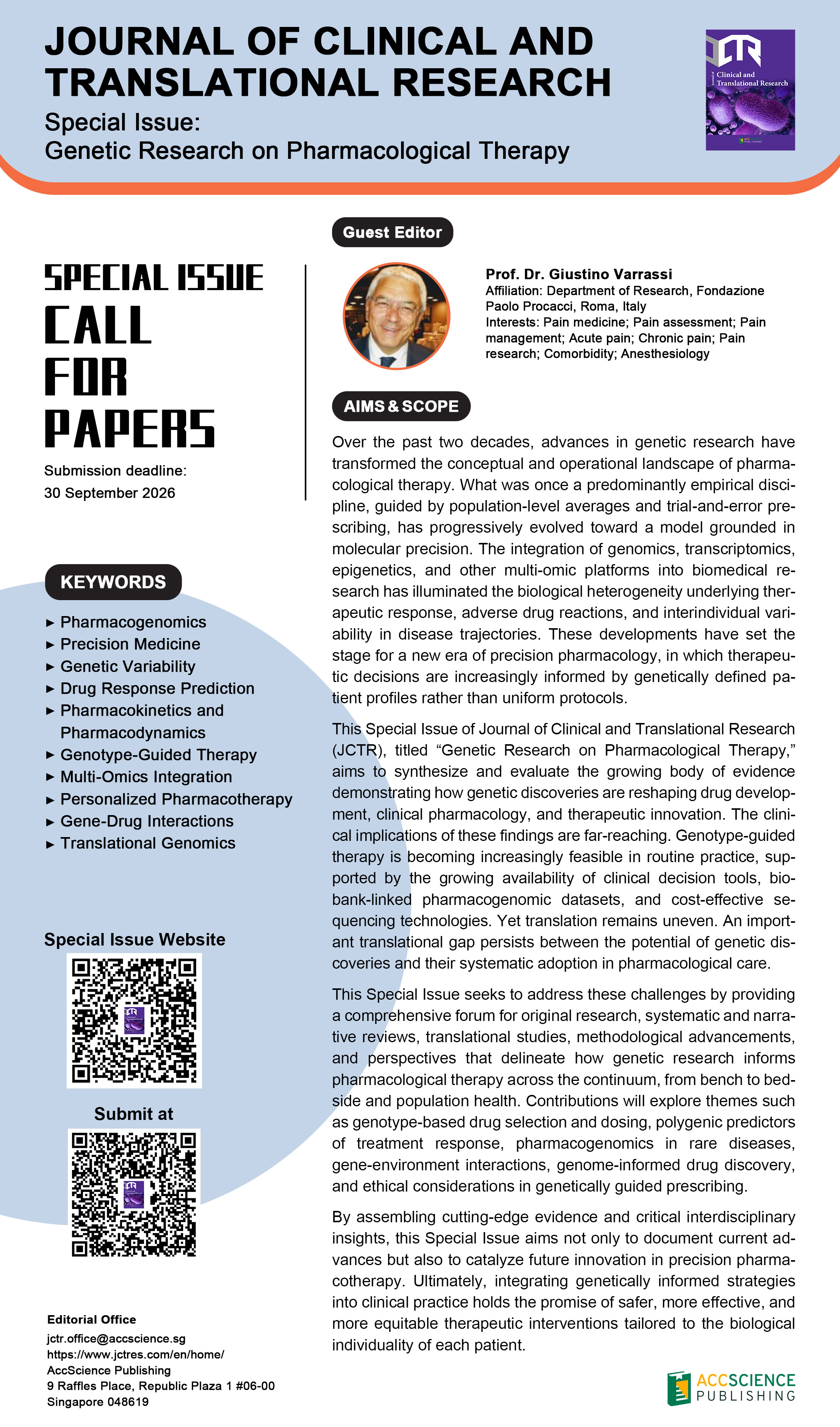
Over the past two decades, advances in genetic research have transformed the conceptual and operational landscape of pharmacological therapy. What was once a predominantly empirical discipline, guided by population-level averages and trial-and-error prescribing, has progressively evolved toward a model grounded in molecular precision. The integration of genomics, transcriptomics, epigenetics, and other multi-omic platforms into biomedical research has illuminated the biological heterogeneity underlying therapeutic response, adverse drug reactions, and interindividual variability in disease trajectories. These developments have set the stage for a new era of precision pharmacology, in which therapeutic decisions are increasingly informed by genetically defined patient profiles rather than uniform protocols. Several examples are already present in the field of cardiovascular diseases.
This Special Issue of the Journal of Clinical and Translational Research (JCTR), titled “Genetic Research on Pharmacological Therapy”, aims to synthesize and evaluate the growing body of evidence demonstrating how genetic discoveries are reshaping drug development, clinical pharmacology, and therapeutic innovation. Rapidly expanding genetic datasets, generated through next-generation sequencing, genome-wide association studies (GWAS), and single-cell multi-omics, have provided mechanistic insights into drug metabolism, transport, and target engagement. For instance, polymorphisms in cytochrome P450 isoenzymes, such as CYP2D6, CYP2C19, and CYP3A5, have revealed reproducible associations with variable efficacy and toxicity across several drug classes, profoundly influencing prescribing algorithms in psychiatry, oncology, cardiology, and pain medicine. Beyond pharmacokinetics, genetic research has also deepened our understanding of pharmacodynamics, facilitating the identification of genetically defined responders and non-responders to targeted therapies, monoclonal antibodies, and biologics.
The clinical implications of these findings are far-reaching. Genotype-guided therapy is becoming increasingly feasible in routine practice, supported by the growing availability of clinical decision tools, biobank-linked pharmacogenomic datasets, and cost-effective sequencing technologies . Yet translation remains uneven: the integration of genetic data into prescribing workflows is challenged by disparities in evidence robustness, lack of consensus guidelines for many variants, insufficient representation of diverse populations in genomic research, and practical barriers such as cost, regulatory heterogeneity, and limited clinician training. As a result, an important translational gap persists between the potential of genetic discoveries and their systematic adoption in pharmacological care.
This Special Issue seeks to address these challenges by providing a comprehensive forum for original research, systematic and narrative reviews, translational studies, methodological advancements, and perspectives that delineate how genetic research informs pharmacological therapy across the continuum, from bench to bedside and population health. Contributions will explore themes such as genotype-based drug selection and dosing, polygenic predictors of treatment response, pharmacogenomics in rare diseases, gene-environment interactions, genome-informed drug discovery, and ethical considerations in genetically guided prescribing.
By assembling cutting-edge evidence and critical interdisciplinary insights, this Special Issue aims not only to document current advances but also to catalyze future innovation in precision pharmacotherapy. Ultimately, integrating genetically informed strategies into clinical practice holds the promise of safer, more effective, and more equitable therapeutic interventions tailored to the biological individuality of each patient.