

Differential dependencies and therapeutic potential of HK2 and PKM in the hypoxic microenvironment of multiple myeloma

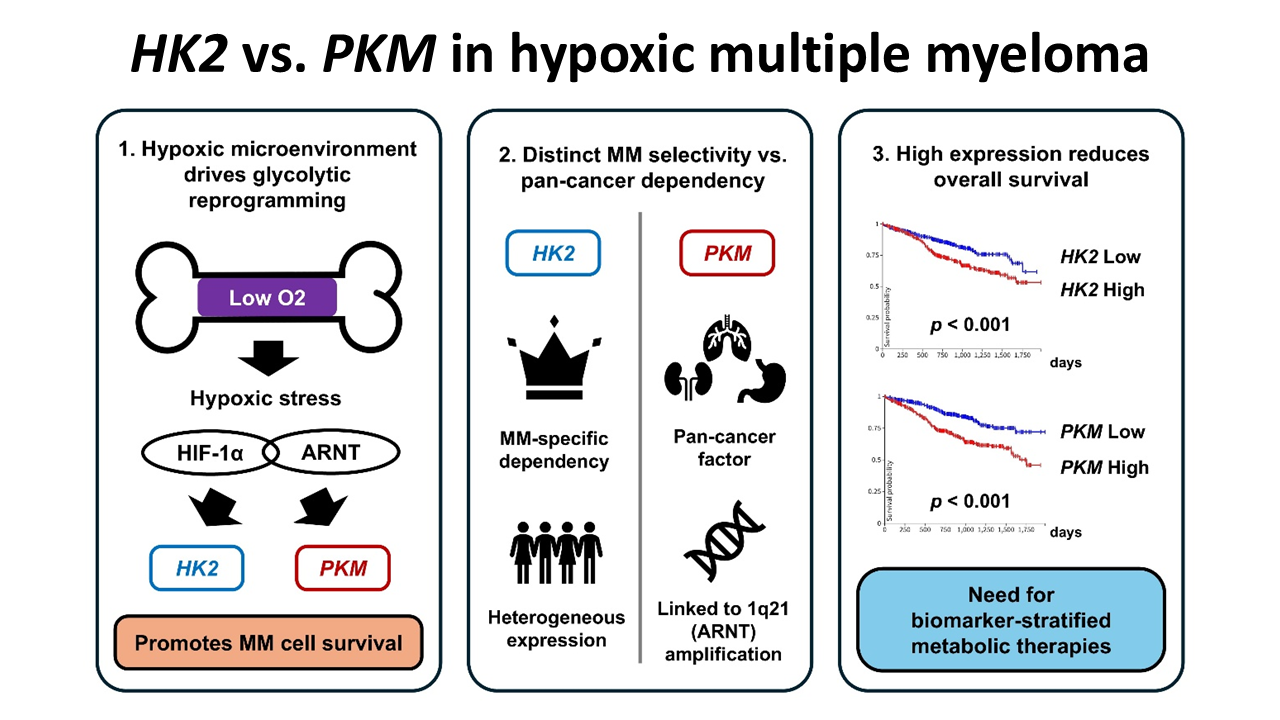
Multiple myeloma (MM) is a hematological malignancy that proliferates within the bone marrow, where hypoxic stress in the microenvironment leads to treatment resistance. In this study, we comprehensively evaluated whether hypoxia-inducible glycolytic genes represent promising therapeutic targets for MM, using in vitro functional analyses and large-scale in silico data analyses. Among the glycolytic genes whose expression is upregulated under hypoxic conditions, knockdown of HK2 and PKM strongly induced hypoxia-specific apoptosis in MM cells. Database analysis revealed that PKM is a universal survival factor across a wide range of cancer types. In contrast, HK2 exhibited extremely high disease-specific dependency, and MM showed the highest HK2 dependence among the 28 cancer types evaluated. Furthermore, while PKM expression positively correlated with ARNT (hypoxia-inducible factor 1 beta) on the 1q21 chromosome and followed a normal distribution, HK2 expression showed marked heterogeneity among patients. Clinically, high expression of HK2 and PKM is associated with a significant reduction in overall survival. The present analysis reflects total PKM expression, and the dominant role of PKM2 requires further validation. In conclusion, HK2 and PKM are poor prognostic factors for MM survival under hypoxic conditions, suggesting the importance of stratifying patients for metabolically targeted therapy based on their molecular profiles, such as HK2 expression levels and 1q21 amplification status.
Abdel-Wahab, A. F., Mahmoud, W., & Al-Harizy, R. M. (2019). Targeting glucose metabolism to suppress cancer progression: Prospective of anti-glycolytic cancer therapy. Pharmacological Research, 150, 104511. https://doi.org/10.1016/j.phrs.2019.104511
Abe, Y., Ikeda, S., Kitadate, A., Narita, K., Kobayashi, H., Miura, D., Takeuchi, M., O’uchi, E., O’uchi, T., & Matsue, K. (2019). Low hexokinase-2 expression-associated false-negative 18F-FDG PET/CT as a potential prognostic predictor in patients with multiple myeloma. European Journal of Nuclear Medicine and Molecular Imaging, 46(6), 1345-1350. https://doi.org/10.1007/s00259-019-04312-9
Alberge, J.-B., Kraeber-Bodéré, F., Jamet, B., Touzeau, C., Caillon, H., Wuilleme, S., Béné, M.-C., Kampfenkel, T., Sonneveld, P., van Duin, M., Avet-Loiseau, H., Corre, J., Magrangeas, F., Carlier, T., Bodet-Milin, C., Chérel, M., Moreau, P., Minvielle, S., & Bailly, C. (2022). Molecular signature of 18F-FDG PET biomarkers in newly diagnosed multiple myeloma patients: A genome-wide transcriptome analysis from the CASSIOPET study. Journal of Nuclear Medicine, 63(7), 1008-1013. https://doi.org/10.2967/jnumed.121.262884
Anastasiou, D., Yu, Y., Israelsen, W. J., Jiang, J.-K., Boxer, M. B., Hong, B. S., Tempel, W., Dimov, S., Shen, M., Jha, A., Yang, H., Mattaini, K. R., Metallo, C. M., Fiske, B. P., Courtney, K. D., Malstrom, S., Khan, T. M., Kung, C., Skoumbourdis, A. P., … Vander Heiden, M. G. (2012). Pyruvate kinase M2 activators promote tetramer formation and suppress tumorigenesis. Nature Chemical Biology, 8(10), 839-847. https://doi.org/10.1038/nchembio.1060
Caillot, M., Bourgeais, J., Dakik, H., Costé, É., Mazure, N. M., Lelièvre, É., Coqueret, O., Hérault, O., Mazurier, F., & Sola, B. (2020). Cyclin D1 targets hexokinase 2 to control aerobic glycolysis in myeloma cells. Oncogenesis, 9(7), 68. https://doi.org/10.1038/s41389-020-00253-3
Dang, C. V. (2007). The interplay between MYC and HIF in the Warburg effect. In Ernst Schering Foundation Symposium Proceedings (pp. 35–53). Springer Berlin Heidelberg. https://doi.org/10.1007/2789_2008_088
Goldman, M. J., Craft, B., Hastie, M., Repečka, K., McDade, F., Kamath, A., Banerjee, A., Luo, Y., Rogers, D., Brooks, A. N., Zhu, J., & Haussler, D. (2020). Visualizing and interpreting cancer genomics data via the Xena platform. Nature Biotechnology, 38(6), 675-678. https://doi.org/10.1038/s41587-020-0546-8
Gordan, J. D., Thompson, C. B., & Simon, M. C. (2007). HIF and c-Myc: Sibling rivals for control of cancer cell metabolism and proliferation. Cancer Cell, 12(2), 108-113. https://doi.org/10.1016/j.ccr.2007.07.006
He, K., Tao, F., Lu, Y., Fang, M., Huang, H., & Zhou, Y. (2025). The role of HK2 in tumorigenesis and development: Potential for targeted therapy with natural products. International Journal of Medical Sciences, 22(4), 790-805. https://doi.org/10.7150/ijms.105553
He, Y., Wang, Y., Liu, H., Xu, X., He, S., Tang, J., Huang, Y., Miao, X., Wu, Y., Wang, Q., & Cheng, C. (2015). Pyruvate kinase isoform M2 (PKM2) participates in multiple myeloma cell proliferation, adhesion and chemoresistance. Leukemia Research, 39(12), 1428-1436. https://doi.org/10.1016/j.leukres.2015.09.019
Huang, L. E., Arany, Z., Livingston, D. M., & Bunn, H. F. (1996). Activation of hypoxia-inducible transcription factor depends primarily upon redox-sensitive stabilization of its alpha subunit. Journal of Biological Chemistry, 271(50), 32253-32259. https://doi.org/10.1074/jbc.271.50.32253
Ikeda, S., Abe, F., Matsuda, Y., Kitadate, A., Takahashi, N., & Tagawa, H. (2020). Hypoxia-inducible hexokinase-2 enhances anti-apoptotic function via activating autophagy in multiple myeloma. Cancer Science, 111(11), 4088-4101. https://doi.org/10.1111/cas.14614
Ikeda, S., & Tagawa, H. (2021). Impact of hypoxia on the pathogenesis and therapy resistance in multiple myeloma. Cancer Science, 112(10), 3995-4004. https://doi.org/10.1111/cas.15087
Kawano, Y., Kikukawa, Y., Fujiwara, S., Wada, N., Okuno, Y., Mitsuya, H., & Hata, H. (2013). Hypoxia reduces CD138 expression and induces an immature and stem cell-like transcriptional program in myeloma cells. International Journal of Oncology, 43(6), 1809-1816. https://doi.org/10.3892/ijo.2013.2134
Kumar, S., Kats, L. M., & Gruber, E. (2026). Epigenetic reprogramming in multiple myeloma: Challenges and opportunities. International Journal of Cancer, 158(2), 423–432. https://doi.org/10.1002/ijc.35426
Lis, P., Dyląg, M., Niedźwiecka, K., Ko, Y., Pedersen, P., Goffeau, A., & Ułaszewski, S. (2016). The HK2 dependent “Warburg effect” and mitochondrial oxidative phosphorylation in cancer: Targets for effective therapy with 3-bromopyruvate. Molecules, 21(12), 1730. https://doi.org/10.3390/molecules21121730
Maiso, P., Huynh, D., Moschetta, M., Sacco, A., Aljawai, Y., Mishima, Y., Asara, J. M., Roccaro, A. M., Kimmelman, A. C., & Ghobrial, I. M. (2015). Metabolic signature identifies novel targets for drug resistance in multiple myeloma. Cancer Research, 75(10), 2071-2082. https://doi.org/10.1158/0008-5472.CAN-14-3400
Muz, B., de la Puente, P., Azab, F., Luderer, M., & Azab, A. K. (2014). Hypoxia promotes stem cell-like phenotype in multiple myeloma cells. Blood Cancer Journal, 4(12), e262. https://doi.org/10.1038/bcj.2014.82
Nakano, A., Miki, H., Nakamura, S., Harada, T., Oda, A., Amou, H., Fujii, S., Kagawa, K., Takeuchi, K., Ozaki, S., Matsumoto, T., & Abe, M. (2012). Up-regulation of hexokinaseII in myeloma cells: targeting myeloma cells with 3-bromopyruvate. Journal of Bioenergetics and Biomembranes, 44(1), 31-38. https://doi.org/10.1007/s10863-012-9412-9
Nasso, M. E., Bottaro, A., Gerace, D., Russo, S., Mannina, D., & Allegra, A. (2026). The shape-shifting myeloma: Adaptive plasticity as a hallmark of relapse and refractoriness. Cancers, 18(12), 1873. https://doi.org/10.3390/cancers18121873
Olszewska-Szopa, M., Vesole, D. H., & Jurczyszyn, A. (2026). Quad-exposed/refractory multiple myeloma: Patients previously treated with anti-CD38, IMiDs, proteasome inhibitors, and BCMA-targeted therapies. Clinical Lymphoma, Myeloma & Leukemia, 26(7), e935-e941. https://doi.org/10.1016/j.clml.2026.04.021
Pajak, B., Siwiak, E., Sołtyka, M., Priebe, A., Zieliński, R., Fokt, I., Ziemniak, M., Jaśkiewicz, A., Borowski, R., Domoradzki, T., & Priebe, W. (2019). 2-Deoxy-d-glucose and its analogs: From diagnostic to therapeutic agents. International Journal of Molecular Sciences, 21(1), 234. https://doi.org/10.3390/ijms21010234
Park, J. H., Kundu, A., Lee, S. H., Jiang, C., Lee, S. H., Kim, Y. S., Kyung, S. Y., Park, S. H., & Kim, H. S. (2021). Specific pyruvate kinase M2 inhibitor, compound 3K, induces autophagic cell death through disruption of the glycolysis pathway in ovarian cancer cells. International Journal of Biological Sciences, 17(8), 1895-1908. https://doi.org/10.7150/ijbs.59855
Patra, K. C., Wang, Q., Bhaskar, P. T., Miller, L., Wang, Z., Wheaton, W., Chandel, N., Laakso, M., Muller, W. J., Allen, E. L., Jha, A. K., Smolen, G. A., Clasquin, M. F., Robey, R. B., & Hay, N. (2013). Hexokinase 2 is required for tumor initiation and maintenance and its systemic deletion is therapeutic in mouse models of cancer. Cancer Cell, 24(2), 213-228. https://doi.org/10.1016/j.ccr.2013.06.014
Rasche, L., Angtuaco, E., McDonald, J. E., Buros, A., Stein, C., Pawlyn, C., Thanendrarajan, S., Schinke, C., Samant, R., Yaccoby, S., Walker, B. A., Epstein, J., Zangari, M., van Rhee, F., Meissner, T., Goldschmidt, H., Hemminki, K., Houlston, R., Barlogie, B., … Weinhold, N. (2017). Low expression of hexokinase-2 is associated with false-negative FDG-positron emission tomography in multiple myeloma. Blood, 130(1), 30-34. https://doi.org/10.1182/blood-2017-03-774422
Şavluğ İpek, Ӧ., Sucu, B. O., Selvi, S., Koksalar Alkan, F., Tiryaki, B., Alkan, H. K., Sayyah, E., Tolu, İ., Güzel, M., Durdağı, S., Öztürk, N., & Korkaya, H. (2025). Anti-cancer efficacy of novel lonidamine derivatives: Design, synthesis, in vitro, in vivo, and computational studies targeting hexokinase-2. European Journal of Medicinal Chemistry, 296, 117890. https://doi.org/10.1016/j.ejmech.2025.117890
Semenza, G. L. (2009). Regulation of cancer cell metabolism by hypoxia-inducible factor 1. Seminars in Cancer Biology, 19(1), 12-16. https://doi.org/10.1016/j.semcancer.2008.11.009
Semenza, G. L., Jiang, B.-H., Leung, S. W., Passantino, R., Concordet, J.-P., Maire, P., & Giallongo, A. (1996). Hypoxia response elements in the aldolase A, enolase 1, and lactate dehydrogenase A gene promoters contain essential binding sites for hypoxia-inducible factor 1. Journal of Biological Chemistry, 271(51), 32529-32537. https://doi.org/10.1074/jbc.271.51.32529
Shimada, K., Bachman, J. A., Muhlich, J. L., & Mitchison, T. J. (2021). shinyDepMap, a tool to identify targetable cancer genes and their functional connections from Cancer Dependency Map data. eLife, 10, e57116. https://doi.org/10.7554/eLife.57116
Tsherniak, A., Vazquez, F., Montgomery, P. G., Weir, B. A., Kryukov, G., Cowley, G. S., Gill, S., Harrington, W. F., Pantel, S., Krill-Burger, J. M., Meyers, R. M., Ali, L., Goodale, A., Lee, Y., Jiang, G., Hsiao, J., Gerath, W. F. J., Howell, S., Merkel, E., … Hahn, W. C. (2017). Defining a Cancer Dependency Map. Cell, 170(3), 564-576.e16. https://doi.org/10.1016/j.cell.2017.06.010
Vander Heiden, M. G., Cantley, L. C., & Thompson, C. B. (2009). Understanding the Warburg effect: The metabolic requirements of cell proliferation. Science, 324(5930), 1029-1033. https://doi.org/10.1126/science.1160809
Wu, C., Yang, T., Liu, Y., Lu, Y., Yang, Y., Liu, X., Liu, X., Ye, L., Sun, Y., Wang, X., Li, Q., Yang, P., Yu, X., Gao, S., Kumar, S., Jin, F., Dai, Y., & Li, W. (2018). ARNT/HIF-1β links high-risk 1q21 gain and microenvironmental hypoxia to drug resistance and poor prognosis in multiple myeloma. Cancer Medicine, 7(8), 3899-3911. https://doi.org/10.1002/cam4.1596
Xu, S., Zhou, T., Doh, H. M., Trinh, K. R., Catapang, A., Lee, J. T., Braas, D., Bayley, N. A., Yamada, R. E., Vasuthasawat, A., Sasine, J. P., Timmerman, J. M., Larson, S. M., Kim, Y., MacLeod, A. R., Morrison, S. L., & Herschman, H. R. (2019). An HK2 antisense oligonucleotide induces synthetic lethality in HK1-HK2+ multiple myeloma. Cancer Research, 79(10), 2748-2760. https://doi.org/10.1158/0008-5472.CAN-18-2799
Zhan, F., Colla, S., Wu, X., Chen, B., Stewart, J. P., Kuehl, W. M., Barlogie, B., & Shaughnessy, J. D., Jr. (2007). CKS1B, overexpressed in aggressive disease, regulates multiple myeloma growth and survival through SKP2- and p27Kip1-dependent and -independent mechanisms. Blood, 109(11), 4995–5001. https://doi.org/10.1182/blood-2006-07-038703
Zhang, J., Ouyang, F., Gao, A., Zeng, T., Li, M., Li, H., Zhou, W., Gao, Q., Tang, X., Zhang, Q., Ran, X., Tian, G., Quan, X., Tang, Z., Zou, J., Zeng, Y., Long, Y., & Li, Y. (2024). ESM1 enhances fatty acid synthesis and vascular mimicry in ovarian cancer by utilizing the PKM2-dependent Warburg effect within the hypoxic tumor microenvironment. Molecular Cancer, 23(1), 94. https://doi.org/10.1186/s12943-024-02009-8
Zhu, X., Wang, Y., He, Y., Li, Y., Wang, C., Zeng, R., Ouyang, Q., Su, C., Hu, Q., Lu, G., Xiao, L., & Zhou, H. (2026). Targeting metabolic reprogramming in multiple myeloma: Molecular mechanisms and potential therapeutic targets. Critical Reviews in Oncology/Hematology, 222, 105257. https://doi.org/10.1016/j.critrevonc.2026.105257