
Dual-crosslinked hydrogels for tissue engineering: A comprehensive systematic review and meta-analysis of emerging strategies

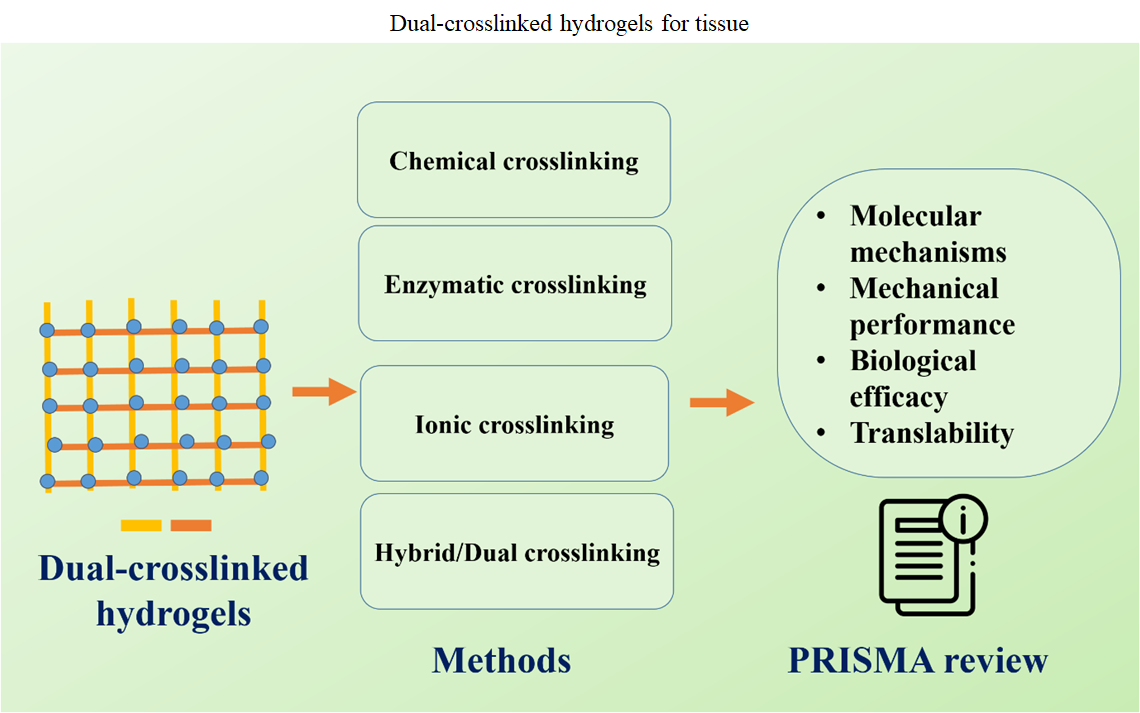
Advancements in tissue engineering rely on the development of more sophisticated scaffolds that can replicate the properties of native tissues and promote healing. This systematic review and meta-analysis, conducted following Preferred Reporting Items for Systematic Reviews and Meta-Analyses (PRISMA) guidelines, synthesizes the latest research (2015–2025) on dual-crosslinked smart scaffolds—materials capable of both covalent and dynamic interactions—to evaluate their molecular mechanisms, mechanical performance, biological efficacy, and potential for clinical translation. The review reveals that combining dual-crosslinking chemistries—such as covalent Schiff bases, ionic interactions, and supramolecular bonds—synergistically enhances scaffold stability, stimuli-responsiveness, and bioactivity across various tissues, including bone, cartilage, skin, and vascular tissues. Quantitative data demonstrate degradation processes aligned with healing timelines, Young’s moduli tailored to specific environments, and tissue-relevant mechanical properties. Despite promising preclinical results showing improved cellular viability, differentiation, and functional tissue regeneration, the understanding of the underlying molecular interactions remains limited. Additionally, evaluation tools lack standardization, and incorporating complex chemistries into clinical practice continues to pose challenges. Future directions emphasize the rational design of stimuli-responsive, bioinspired, and adaptive systems, combined with computational modeling, to enable personalized regenerative therapies. Overcoming these scientific and translational hurdles is essential to realize the full potential of dual-crosslinked scaffolds in next-generation tissue engineering.
- Abouna GM. Organ shortage crisis: problems and possible solutions. Transplant Proc. 2008;40(1):34–38. doi: 10.1016/j.transproceed.2007.11.067
- Edgar L, Pu T, Porter B, et al. Regenerative medicine, organ bioengineering and transplantation. Br J Surg. 2020;107(7):793–800. doi: 10.1002/bjs.11686
- Badekila AK, Kini S, Jaiswal AK. Fabrication techniques of biomimetic scaffolds in three-dimensional cell culture: A review. J Cell Physiol. 2021;236(2):741–762. doi: 10.1002/jcp.29935
- Filippi M, Born G, Chaaban M, Scherberich A. Natural polymeric scaffolds in bone regeneration. Front Bioeng Biotechnol. 2020;8:474. doi: 10.3389/fbioe.2020.00474
- Carotenuto F, Politi S, Ul Haq A, et al. From soft to hard biomimetic materials: tuning micro/nano-architecture of scaffolds for tissue regeneration. Micromachines (Basel). 2022;13(5):780. doi: 10.3390/mi13050780
- Wang L, Wang C, Wu S, Fan Y, Li X. Influence of the mechanical properties of biomaterials on degradability, cell behaviors and signaling pathways: current progress and challenges. Biomater Sci. 2020;8(10):2714–2733. doi: 10.1039/D0BM00269K
- Mndlovu H, Kumar P, du Toit LC, Choonara YE. A review of biomaterial degradation assessment approaches employed in the biomedical field. NPJ Mater Degrad. 2024;8(1):66. doi: 10.1038/s41529-024-00487-1
- Pagar RR, Musale SR, Pawar G, Kulkarni D, Giram PS. Comprehensive review on the degradation chemistry and toxicity studies of functional materials. ACS Biomater Sci Eng. 2022;8(6):2161–2195. doi: 10.1021/acsbiomaterials.1c01304
- Percival KM, Paul V, Husseini GA. Recent advancements in bone tissue engineering: integrating smart scaffold technologies and bio-responsive systems for enhanced regeneration. Int J Mol Sci. 2024;25(11):6012. doi: 10.3390/ijms25116012
- El-Husseiny HM, Mady EA, El-Dakroury WA, et al. Smart/stimuli-responsive hydrogels: state-of-the-art platforms for bone tissue engineering. Appl Mater Today. 2022;29:101560.doi: 10.1016/j.apmt.2022.101560
- Costa BN, Marote A, Barbosa C, et al. Smart polymeric 3D micro scaffolds hosting spheroids for neuronal research via quantum metrology. Adv Health c Mater. 2025;14(7):2403875. doi: 10.1002/adhm.202403875
- Lee JM, Chee JW, Wong JZ, Foong LY, Nafea M. Methods, materials, shape programming, and applications of 4D printing. In: 4D Printing Technology: Principles, Materials and Applications. Hoboken, NJ, USA: Wiley; 2025. pp. 315–344. doi: 10.1002/9781394213795.ch10
- Zhang M, Choi W, Kim M, et al. Recent advances in environmentally friendly dual-crosslinking polymer networks. Angew Chem Int Ed Engl. 2024;63(24):e202318035. doi: 10.1002/anie.202318035
- Hammer L, Van Zee NJ, Nicolay R. Dually crosslinked polymer networks incorporating dynamic covalent bonds. Polymers (Basel). 2021;13(3):396. doi: 10.3390/polym13030396
- Rodin M, Li J, Kuckling D. Dually cross-linked single networks: structures and applications. Chem Soc Rev. 2021;50(14):8147–8177. doi: 10.1039/D0CS01585G
- Rumon MM, Rahman MS, Akib AA, et al. Progress in hydrogel toughening: addressing structural and crosslinking challenges for biomedical applications. Discov Mater.2025;5(1):1–29. doi: 10.1007/s43939-025-00178-x
- Nguyen TD, Lee JS. Dynamic bonds in biopolymers: enhancing performance and properties. Polymers (Basel).2025;17(4):457. doi: 10.3390/polym17040457
- Xu C, Ivanovski S. Clinical translation of personalized bioengineered implant scaffolds. Nat Rev Bioeng.2025;3(5):390–407. doi: 10.1038/s44222-024-00269-z
- Echeverria Molina MI, Malollari KG, Komvopoulos K. Design challenges in polymeric scaffolds for tissue engineering. Front Bioeng Biotechnol. 2021;9:617141.doi: 10.3389/fbioe.2021.617141
- Salvatore L, Gallo N, Natali ML, et al. Mimicking the hierarchical organization of natural collagen: toward the development of ideal scaffolding material for tissue regeneration. Front Bioeng Biotechnol. 2021;9:644595. doi: 10.3389/fbioe.2021.644595
- Abdelaziz AG, Nageh H, Abdo SM, et al. A review of 3Dpolymeric scaffolds for bone tissue engineering: principles, fabrication techniques, immunomodulatory roles, and challenges. Bioengineering (Basel). 2023;10(2):204. doi: 10.3390/bioengineering10020204
- Mahmoudsalehi AO, Soleimani M, Rios KS, Ortega-LaraW, Mamidi N. Advanced 3D scaffolds for corneal stroma regeneration: A preclinical progress. J Mater Chem B.2025;13(21):5980–6020. doi: 10.1039/D5TB00090D
- Zhao J, Zhang Z, Wang C, Yan X. Synergistic dual dynamic bonds in covalent adaptable networks. CCS Chem.2024;6(1):41–56. doi: 10.31635/ccschem.023.202303045
- Wei W, Zhang Z, Wu M, et al. The preparation of starch based green adsorption gel with tunable water channel sthrough extrusion-dual cross-linking method. Int J Biol Macromol. 2025;140818. doi: 10.1016/j.ijbiomac.2025.140818
- Yammine P, El Safadi A, Kassab R, et al. Types of crosslinkers and their applications in biomaterials and bio membranes. Chemistry. 2025;7(2):61. doi: 10.3390/chemistry7020061
- Agnes CJ, Karoichan A, Tabrizian M. The diamond concept enigma: recent trends of its implementation in cross-linked chitosan-based scaffolds for bone tissue engineering. ACS Appl Bio Mater. 2023;6(7):2515–2545.doi: 10.1021/acsabm.3c00108
- Moher D, Liberati A, Tetzlaff J, Altman DG; PRISMA Group. Preferred reporting items for systematic reviews and metaanalyses: the PRISMA statement. Int J Surg. 2010;8(5):336–341.doi: 10.1016/j.ijsu.2010.02.007
- Hooijmans CR, Rovers MM, de Vries RB, Leenaars M, Ritskes-Hoitinga M, Langendam MW. SYRCLE’s risk of bias tool for animal studies. BMC Med Res Metho dol. 2014;14:43. doi: 10.1186/1471-2288-14-43
- Sterne JA, Savović J, Page MJ, et al. RoB 2: a revised tool for assessing risk of bias in randomised trials. BMJ. 2019;366:l4898. doi: 10.1136/bmj.l4898
- Fekete JT, Győrffy B. MetaAnalysisOnline.com: web based tool for the rapid meta-analysis of clinical and epidemiological studies. J Med Internet Res. 2025;27:e64016. doi: 10.2196/64016
- Shen X, Li S, Zhao X, et al. Dual-crosslinked regenerative hydrogel for suture less long-term repair of corneal defect. Bioact Mater. 2023;20(2):434–448.doi: 10.1016/j.bioactmat.2022.06.006
- Bakadia BM, Ahmed AA, Lamboni L, et al. Engineering homologous platelet-rich plasma, platelet-rich plasma derived exosomes, and mesenchymal stem cell-derived exosomes-based dual-crosslinked hydrogels as bioactive diabetic wound dressings. Bioact Mater. 2023;28(10):74–94.doi: 10.1016/j.bioactmat.2023.05.002
- Geng Z, Ji Y, Yu S, et al. Preparation and characterization of a dual cross-linking injectable hydrogel based on sodium alginate and chitosan quaternary ammonium salt. Carbohydr Res. 2021;507:108389. doi: 10.1016/j.carres.2021.108389
- Chawla D, Kaur T, Joshi A, Singh N. 3D bioprinted alginate gelatin based scaffolds for soft tissue engineering. Int J Biol Macromol. 2020;144:560–567. doi: 10.1016/j.ijbiomac.2019.12.127
- Liu S, Pu Y, Yang R, et al. Boron-assisted dual-crosslinked poly(γ-glutamic acid) hydrogels with high toughness for cartilage regeneration. Int J Biol Macromol. 2020;153:158–168. doi: 10.1016/j.ijbiomac.2020.02.314
- Ko E, Kim H. Preparation of chitosan aerogel crosslinked in chemical and ionical ways by non-acid condition for wound dressing. Int J Biol Macromol. 2020;164:2177–2185. doi: 10.1016/j.ijbiomac.2020.08.008
- Gwon K, Lee S, Kim Y, et al. Construction of a bioactive copper-based metal organic framework-embedded dual crosslinked alginate hydrogel for antimicrobial applications. Int J Biol Macromol. 2023;242:124840. doi: 10.1016/j.ijbiomac.2023.124840
- Singh H, Yadav I, Sheikh WM, et al. Dual cross-linked gellan gum/gelatin-based multifunctional nanocomposite hydrogel scaffold for full-thickness wound healing. Int J Biol Macromol. 2023;251:126349. doi: 10.1016/j.ijbiomac.2023.126349
- Mostafavi A, Daemi H, Rajabi S, Baharvand H. Highly tough and ultrafast self-healable dual physically crosslinked sulfated alginate-based polyurethane elastomers for vascular tissue engineering. Carbo hydr Polym. 2021;257:117632. doi: 10.1016/j.carbpol.2021.117632
- Li Z, Li S, Yang J, et al. 3D bio printed gelatin/gellangum-based scaffold with double-crosslinking network for vascularized bone regeneration. Carbohydr Polym.2022;290:119469. doi: 10.1016/j.carbpol.2022.119469
- Zhang W, Zhang S, Zhao T, Zhang H. An injectable sequential dual-crosslinking catechol-functionalized hyaluronic acid hydrogel for enhanced regeneration of full-thickness burn injury. J Control Release. 2024;369(5):545–555. doi: 10.1016/j.jconrel.2024.04.012
- Mukhopadhyay A, Rajput M, Barui A, et al. Dual crosslinked honey coupled 3D antimicrobial alginate hydrogels for cutaneous wound healing. Mater Sci Eng C Mater Biol Appl. 2020;116:111218. doi: 10.1016/j.msec.2020.111218
- Schwarz S, Kuth S, Distler T, et al. 3D printing and characterization of human naso septal chondrocytes laden dual crosslinked oxidized alginate-gelatin hydrogels for cartilage repair approaches. Mater Sci Eng C Mater Biol Appl.2020;116:111189. doi: 10.1016/j.msec.2020.111189
- Xu L, Zhang Z, Jorgensen AM, et al. Bioprinting a skin patch with dual-crosslinked gelatin (GelMA) and silk fibroin (SilMA): An approach to accelerating cutaneous wound healing. Mater Today Bio. 2023;18:100550. doi: 10.1016/j.mtbio.2023.100550
- Thanasannubanant W, Meewan I, Thongchan J, et al. A porosity design of mycelium chitin-glucan scaffold via hydrothermal fabrication and its dual crosslinking forwound healing applications. Carbohydr Polym Technol Appl.2025;10:100763. doi: 10.1016/j.carpta.2025.100763
- Budharaju H, Sundaramurthi D, Sethuraman S. Efficient dual crosslinking of protein–in–polysaccharide bioink for biofabrication of cardiac tissue constructs. Biomater Adv.2023;152:213486. doi: 10.1016/j.bioadv.2023.213486
- Xu P, Chen P, Sun Y, et al. A novel injectable thermo/photodual-crosslinking hydrogel based on modified chitosan for fast sealing open globe injury. Carbohydr Polym.2024;331:121854. doi: 10.1016/j.carbpol.2024.121854
- Xu M, Qin M, Zhang X, et al. Porous PVA/SA/HA hydrogels fabricated by dual-crosslinking method for bone tissue engineering. J Biomater Sci Polym Ed. 2020;31(6):816–831.doi: 10.1080/09205063.2020.1720155
- Rodell CB, Dusaj NN, Highley CB, Burdick JA. Injectable and cytocompatible tough double network hydrogels through tandem supramolecular and covalent crosslinking. Adv Mater. 2016;28(38):8419–8424.doi: 10.1002/adma.201602268
- Yan J, Krasowska M, Ge W, et al. Combining thermos sensitive physical self-assembly and covalent cycloaddition chemistry as simultaneous dual cross-linking mechanisms for the preparation of injectable hydrogels with tuneable properties. Eur Polym J. 2023;183:111761. doi: 10.1016/j.eurpolymj.2022.111761
- Song Y, Nagai N, Saijo S, et al. In situ formation of injectable chitosan-gelatin hydrogels through double crosslinking for sustained intraocular drug delivery. Mater Sci Eng C Mater Biol Appl. 2018;88:1–12. doi: 10.1016/j.msec.2018.02.022
- Wang H, Yang J, Tian W, et al. A sodium alginate/carboxymethyl chitosan dual-crosslinked injectable hydrogel scaffold with tunable softness/hardness for bone regeneration. Int J Biol Macromol. 2024;257:128700. doi: 10.1016/j.ijbiomac.2023.128700
- Zeng H, Liu X, Zhang Z, et al. Self-healing, injectable hydrogel based on dual dynamic covalent cross-linking against postoperative abdominal cavity adhesion. Acta Bio mater. 2022;151:210-222. doi: 10.1016/j.actbio.2022.08.030
- Shehzad A, Mukasheva F, Moazzam M, et al. Dual cross linking of gelatin-based hydrogels: promising compositions for a 3D printed organotypic bone model. Bioeng (Basel). 2023;10(6):704.doi: 10.3390/bioengineering10060704
- Wang L, Li J, Zhang D, et al. Dual-enzymatically crosslinked and injectable hyaluronic acid hydrogels for potential application in tissue engineering. RSC Adv. 2020;10(5):2870–2876. doi: 10.1039/C9RA09531D
- Chen M, Tan H, Xu W, et al. A self-healing, magnetic and injectable biopolymer hydrogel generated by dual crosslinking for drug delivery and bone repair. Acta Biomater.2022;153:159–177. doi: 10.1016/j.actbio.2022.09.036
- Iglesias-Mejuto A, García-González CA. 3D-printed, dual crosslinked and sterile aerogel scaffolds for bone tissue engineering. Polym (Basel). 2022;14(6):1211. doi: 10.3390/polym14061211
- Wang Q, Ran X, Wang J, et al. Elastic fiber-reinforced silk fibroin scaffold with a double-crosslinking network for human ear-shaped cartilage regeneration. Adv Fiber Mater.2023;5(3):1008–1024. doi: 10.1007/s42765-023-00266-8
- Zhang X, Huang P, Jiang G, et al. A novel magnesium ionin corporating dual-crosslinked hydrogel to improve bone scaffold-mediated osteogenesis and angiogenesis. Mater SciEng C Mater Biol Appl. 2021;121:111868. doi: 10.1016/j.msec.2021.111868
- Milne C, Song R, Johnson M, et al. Dual-Modified Hyaluronic Acid for Tunable Double Cross-Linked Hydrogel Adhesives. Biomacromolecules. 2024;25(4):2645–2655. doi: 10.1021/acs.biomac.4c00194
- Yang J, Li R, Wang X, et al. Mechanically tunable fiber-based hydrogel activates PIEZO1–integrin axis for enhanced bone repair. J Nanobiotechnology. 2025;23:653. doi: 10.1186/s12951-025-03653-y
- Zhang Z, Ding Y, Yuan H, et al. A multiple-crosslinked injectable hydrogel for modulating tissue micro environmentand accelerating infected diabetic wound repair. J Nano biotechnology. 2025;23:285. doi: 10.1186/s12951-025-03285-2
- Choi H, Choi WS, Jeong JO. A review of advanced hydrogel applications for tissue engineering and drug delivery systems as biomaterials. Gels. 2024;10(11):693. doi: 10.3390/gels10110693
- Han GY, Park JY, Lee TH, Yi MB, Kim HJ. Highly resilient dual-crosslinked hydrogel adhesives based on adopamine-modified crosslinker. ACS Appl Mater Interfaces.2022;14(32):36304–36314. doi: 10.1021/acsami.2c04791
- Feng ZT, Tsai WB. Dual cross-linking of catechol–alginate hydrogels: A strategy for enhanced stability and sustained drug delivery. ACS Omega. 2025;10(2):e5c00077. doi: 10.1021/acsomega.5c00077
- Li M, Li F, Xu J, et al. Bioadhesive chitosan hydrogel with dynamic covalent bonds and sustained kartogen in release for endogenous cartilage regeneration. Front Bio eng Biotechnol. 2025;13:1606726. doi: 10.3389/fbioe.2025.1606726