
From Field to Fork: Microplastics in Agricultural Water Systems – Fate, Food Chain Transfer, and Integrated Risk Assessment

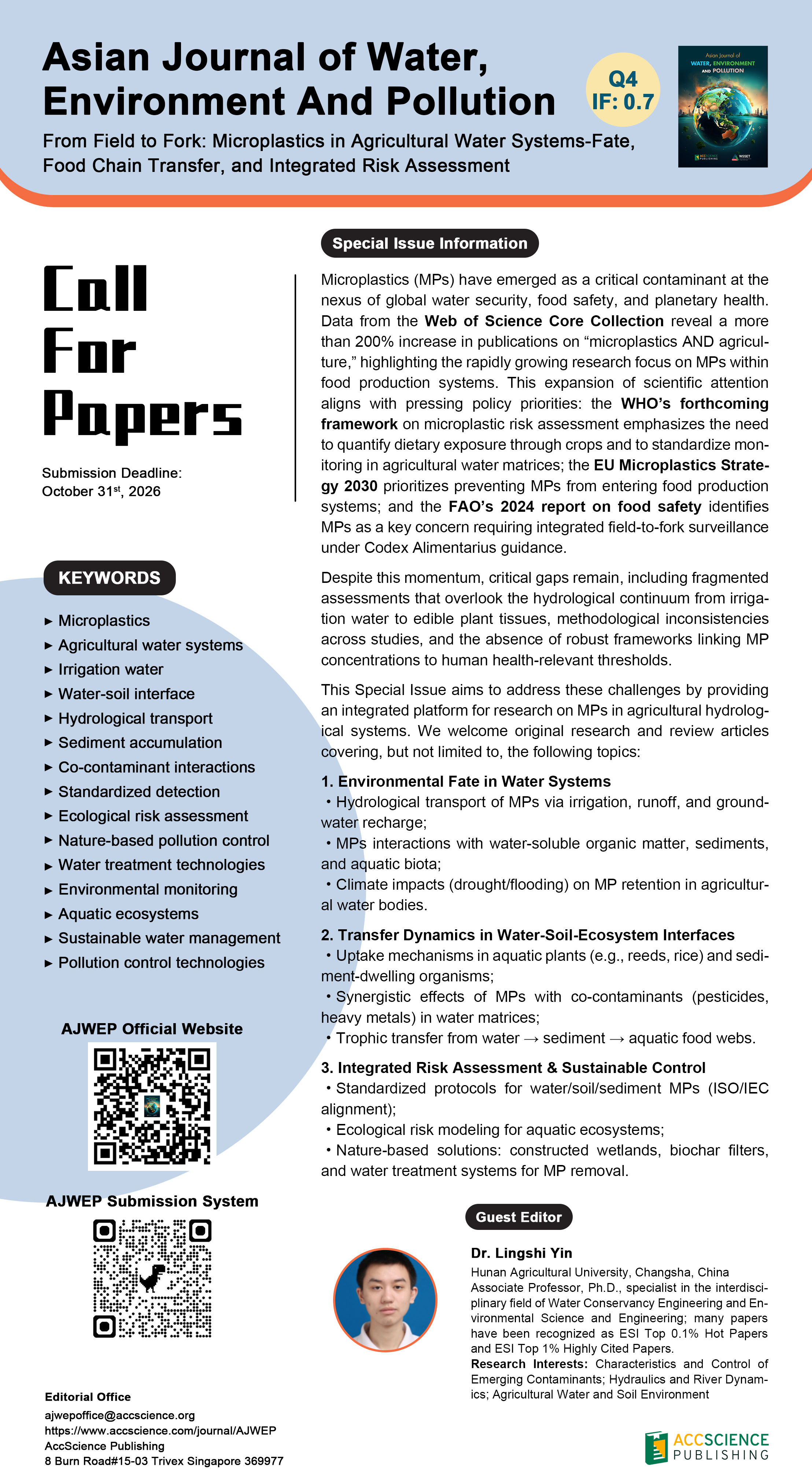
Microplastics (MPs) have emerged as a critical contaminant at the nexus of global water security, food safety, and planetary health. Data from the Web of Science Core Collection reveal a more than 200% increase in publications on “microplastics AND agriculture,” highlighting the rapidly growing research focus on MPs within food production systems. This expansion of scientific attention aligns with pressing policy priorities: the WHO’s forthcoming framework on microplastic risk assessment emphasizes the need to quantify dietary exposure through crops and to standardize monitoring in agricultural water matrices; the EU Microplastics Strategy 2030 prioritizes preventing MPs from entering food production systems; and the FAO’s 2024 report on food safety identifies MPs as a key concern requiring integrated field-to-fork surveillance under Codex Alimentarius guidance.
Despite this momentum, critical gaps remain, including fragmented assessments that overlook the hydrological continuum from irrigation water to edible plant tissues, methodological inconsistencies across studies, and the absence of robust frameworks linking MP concentrations to human health-relevant thresholds.
This Special Issue aims to address these challenges by providing an integrated platform for research on MPs in agricultural hydrological systems. We welcome original research and review articles covering, but not limited to, the following topics:
- Environmental Fate in Water Systems
- Hydrological transport of MPs via irrigation, runoff, and groundwater recharge;
- MPs interactions with water-soluble organic matter, sediments, and aquatic biota;
- Climate impacts (drought/flooding) on MP retention in agricultural water bodies.
- Transfer Dynamics in Water-Soil-Ecosystem Interfaces
- Uptake mechanisms in aquatic plants (e.g., reeds, rice) and sediment-dwelling organisms;
- Synergistic effects of MPs with co-contaminants (pesticides, heavy metals) in water matrices;
- Trophic transfer from water → sediment → aquatic food webs.
- Integrated Risk Assessment & Sustainable Control
- Standardized protocols for water/soil/sediment MPs (ISO/IEC alignment);
- Ecological risk modeling for aquatic ecosystems (e.g., NLRP3 activation in fish);
- Nature-based solutions: constructed wetlands, biochar filters, and water treatment systems for MP removal.