
A retrospective assessment of rural drinking water quality and influencing factors in Weifang City, China

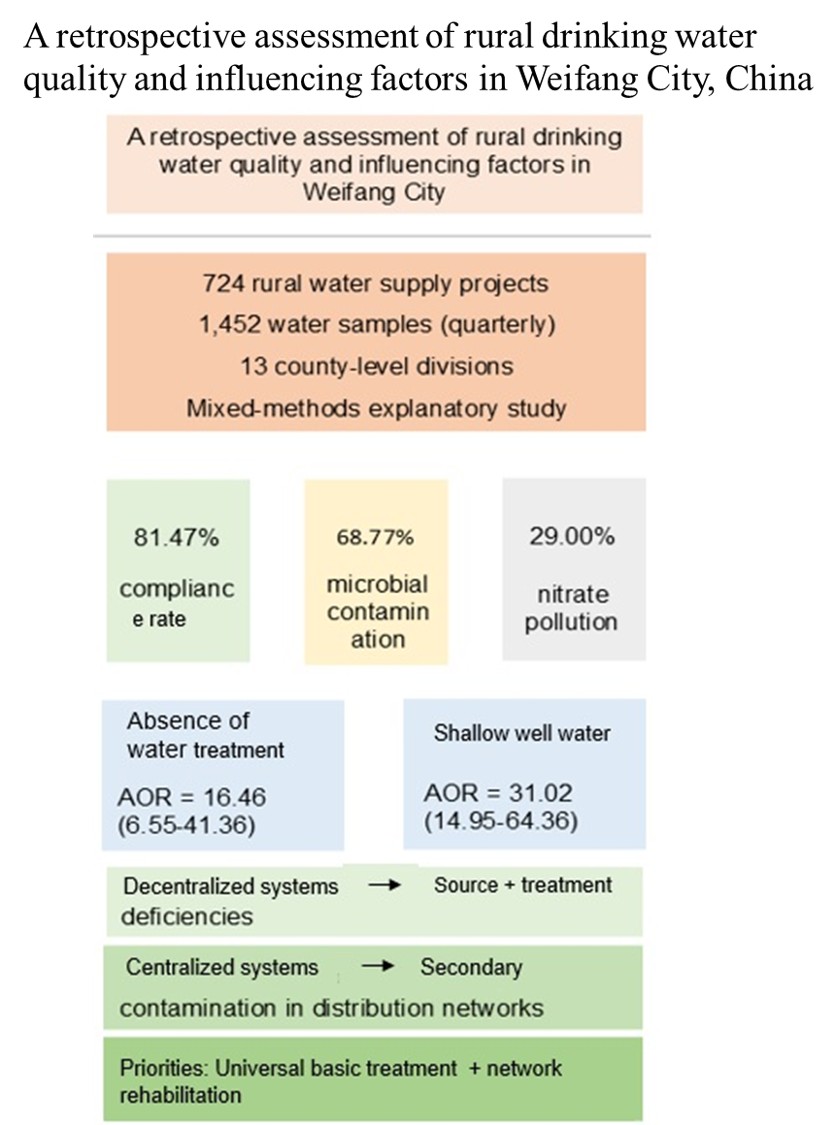
Access to safe drinking water remains a critical, yet unmet, public health priority in rural China. Weifang City, a major agricultural region, exemplifies this challenge, but evidence to guide targeted, context-specific interventions is lacking. We conducted a mixed-methods explanatory study in Weifang City from August 2024 to May 2025. A repeated cross-sectional survey of all 724 rural water supply projects was performed, involving 1,452 water samples collected quarterly from factory outlets and end-user taps. Water quality compliance was assessed against China’s national standard (GB 5749-2022). The overall water quality compliance rate was 81.47%. However, an estimated 560,300 rural residents (10.82% of the population served) were exposed to non-compliant water. Microbial contamination was the predominant failure mode (68.77% of non-compliant samples), followed by nitrate pollution (29.00%). Multivariable analysis identified the use of shallow well water as the factor most strongly associated with non-compliance (adjusted odds ratio [AOR] = 31.02; 95% confidence interval [CI]: 14.95–64.36), followed by absence of water treatment (AOR = 16.46; 95% CI: 6.55–41.36). Decentralized systems exhibited the highest failure rates, a risk fully mediated by poor source quality and lack of treatment. Centralized systems showed significant water quality deterioration between treatment plants and taps (93.40% vs. 79.44%), indicating pervasive secondary contamination. Rural drinking water safety in Weifang is compromised through two distinct, modifiable pathways: source and treatment deficiencies in decentralized systems, and secondary contamination in centralized distribution networks. This evidence provides a novel, mixed-methods, risk-based roadmap for transitioning from infrastructure coverage to equitable, sustainable, safe water access.
- World Health Organization. Guidelines for Drinking-Water Quality: Fourth Edition Incorporating the First Addendum. Geneva: World Health Organization; 2017.
- Sun Q, Yang K, Liu T, et al. Health risk assessment of nitrate pollution of drinking groundwater in rural areas of Suihua, China. J Water Health. 2023;21(9):1193-1208. doi: 10.2166/wh.2023.069
- Zhou S, Cao N, Zhang J, Li W, Wang Y, Liu H. Analysis of drinking water quality testing in rural areas. Mod Salt Chem Ind. 2023;50(4):92-94. doi: 10.19465/j.cnki.2095-9710.2023.04.002
- Han Y, Wei Q, Li X, et al. Analysis of drinking water quality in urban and rural areas of a city in Gansu Province. Gansu Sci Technol. 2024;40(2):65-71. doi: 10.20156/j.cnki.2097-2490.2024.02.014
- Chen L, Zhang R, Zhao Y, et al. Analysis of drinking water quality monitoring in Daxing District, Beijing, 2019- 2023. Ind Microbiol. 2024;54(6):201-203. doi: 10.16736/j.cnki.cn41-1434/ts.2024.06.001
- Guan Y, Shan J, Wang X, Zhang L, Liu B. Research report on safety and hygiene assessment of rural drinking water in Weifang and countermeasures. Weifang: National Scientific and Technological Achievements; 2020.
- Qiao S. Analysis of the current situation of drinking water quality in typical rural areas [master’s thesis]. Beijing: Beijing Jiaotong University; 2022.
- Huang S, Guo J, Xie Y, et al. Distribution, sources, and potential health risks of fluoride, total iodine, and nitrate in rural drinking water sources of North and East China. Sci Total Environ. 2023;893:165561. doi: 10.1016/j.scitotenv.2023.165561
- Maimaitijiang A. Analysis of drinking water quality in rural areas of Hetian County. Heilongjiang Hydraul Sci Technol. 2022;50(3):33-36. (In Chinese). Available from: http://dianda.cqvip.com/Qikan/Article/ Detail?id=7106959280&from=Qikan_Article_Detail [Last accessed on December 20, 2025].
- Liu H, Zhang G, Guo H, Wang Z, Qin G. Occurrences of nitrate-contaminated groundwater in the piedmont aquifers: hydrogeochemical characteristics and health risks. Environ Geochem Health. 2024;46(9):366. doi: 10.1007/s10653-024-02166-1
- Zhou Q, Huang J, Guo K, et al. Spatiotemporal distribution of opportunistic pathogens and microbial community in centralized rural drinking water: One year survey in China. Environ Res. 2023;224:115498. doi: 10.1016/j.envres.2022.115045
- Lv LS, Li J, Zhang XE, et al. Multipathway health risk assessment on disinfection byproducts of drinking water in central China: a study of 15,280 samples. J Water Health. 2025;23(6):794-805. doi: 10.2166/wh.2025.027
- Wang S, Chen J, Liu F, et al. Identification of groundwater nitrate sources and its human health risks in a typical agriculture-dominated watershed, North China. Environ Geochem Health. 2024;46(12):495. doi: 10.1007/s10653-024-02276-w
- Li P, Wu J, Qian H. Groundwater quality assessment and hydrogeochemical processes in a typical rural area of the North China Plain. Environ Earth Sci. 2016;75(12):1021. doi: 10.1007/s12665-016-5834-3
- Min F. Problems and countermeasures of drinking water quality testing. China Food Ind. 2024;(6).
- Wan J. Analysis of drinking water quality testing in rural areas. Agric Sci Technol Inf. 2022;(16):121-124. doi: 10.15979/j.cnki.cn62-1057/s.2022.16.012
- Ma H, Chen X, Zhao Y, et al. Analysis of drinking water quality testing in rural areas. Mod Food. 2023;29(18):59-61. doi: 10.16736/j.cnki.cn41-1434/ts.2023.18.019
- Hu MM, Xia YT, Wang L, Xiong CL. Comprehensive assessment of rural drinking water quality in a western China city, 2022. J Environ Hyg. 2024;14(2):151-155. doi: 10.13421/j.cnki.hjwsxzz.2024.02.008
- Angello ZA, Mengist MA. Pollution sources apportionment and suitability assessment of Lah River, Ethiopia: Conjunctive application of multivariate statistical analysis and water quality index. Water Sci Technol. 2024;89(8):2191- 2208. doi: 10.2166/wst.2024.103
- Barnhart BL, Flinders CA, Johnson GT, et al. Ambient water quality criteria derived using probabilistic risk assessment. Integr Environ Assess Manag. 2023;19(2):501- 512. doi: 10.1002/ieam.4683
- Nambiar PVM, Urkude G. An approach to forecast quality of water effectively using machine learning algorithms. Recent Adv Electr Electron Eng. 2025;18(2):161-175. doi: 10.2174/0123520965267326231115071849
- Wang G, Gao HB, Long B, Wu JF. Research progress on nitrate isotope coupled multi-tracer tracing groundwater nitrate pollution. Chin J Appl Ecol. 2024;35(4):970. doi: 10.13287/j.1001-9332.202404.011
- Xu QH, Boelens R, Veldwisch GJ. Rural drinking water governance politics in China: Governmentality schemes and negotiations from below. Polit Geogr. 2022;97:102683. doi: 10.1016/j.polgeo.2022.102703
- Song T, Tu W, Su M, et al. Water quality assessment and its pollution source analysis from spatial and temporal perspectives in small watershed of Sichuan Province, China. Environ Monit Assess. 2024;196(9):856. doi: 10.1007/s10661-024-13017-y
- Jeong H, Park S, Choi B, et al. Machine learning-based water quality prediction using octennial in-situ Daphnia magna biological early warning system data. J Hazard Mater. 2024;465:133196. doi: 10.1016/j.jhazmat.2023.133196
- Yu E, Li Y, Li F, He C, Feng X. Source apportionment and influencing factors of surface water pollution through a combination of multiple receptor models and geodetector. Environ Res. 2024;263(Pt 2):120168. doi: 10.1016/j.envres.2024.120168
- Li Z, Liu H, Zhang C, Fu G. Real-time water quality prediction in water distribution networks using graph neural networks with sparse monitoring data. Water Res. 2024;250:121018. doi: 10.1016/j.watres.2023.121018
- Taylor A, Garretson A, Bieluch KH, et al. A Mixed Methods Approach to Understanding the Public Health Impact of a School-Based Citizen Science Program to Reduce Arsenic in Private Well Water. Environ Health Perspect. 2024;132(8):85001. doi: 10.1289/EHP13421
- Liu L, Xing X, Hu C, Wang H. One-year survey of opportunistic premise plumbing pathogens and free-living amoebae in the tap-water of one northern city of China. J Environ Sci. 2019;77:20-31. doi: 10.1016/j.jes.2018.04.020
- Wang Y, Zhang L, Liu X, et al. Distribution and source analysis of groundwater nitrate in typical vegetable planting areas and surrounding regions taking Weifang City as the study area. Environ Monit Manag Technol. 2025;37(4).
- Braun V, Clarke V. Using thematic analysis in psychology. Qual Res Psychol. 2006;3(2):77-101. doi: 10.1191/1478088706qp063oa
- Li M, Wang J. Analysis of common problems and countermeasures in rural drinking water safety monitoring and investigation. Rural Pract Technol. 2024;(5).
- Zhang W. Research on rural drinking water safety under the background of rural revitalization. Farm Econ Manag. 2024;(3).
- Liu C. Current situation and countermeasures of rural drinking water projects. China Acad J Electron Publ House. 2025;(11).
- Zhao Q. Discussion on water quality monitoring and safe drinking water management countermeasures in rural areas. In: Proceedings of the 2nd Intelligent Engineering and Economic Construction Academic Seminar. April 18-20, 2025, Shenzhen, China. 2025.
- Sun L, Chen H, Wang F, et al. Nitrate sources and microbial community structure characteristics of groundwater in typical areas of northern Anhui. J Hebei Geo Univ. 2025;48(2).
- Chen M. Investigation on the causes of water pollution in rural development: a case study of Jiangsu Province. Environ Sci Manage. 2013;38(8):29-31,36.
38. Qin’an County Water Resources Bureau. Exploration and practice of rural water supply water quality improvement. Water Resour Dev Manag. 2024;10(3).