AccScience Publishing / AJWEP / Online First / DOI: 10.36922/AJWEP026050022
ORIGINAL RESEARCH ARTICLE

Experimental study on pollutant distribution around permeable spur dikes for river ecological engineering

Junhui He1 Tao Yu Yu2* Dejian Wei1 Linfeng Han2
Show Less
1 Department of Engineering Management, Pinglu Canal Group Co., Ltd, Nanning, Guangxi, China
2 National Engineering Research Center for Inland Waterway Regulation, Chongqing Jiaotong University, Chongqing, China
Received: 28 January 2026 | Revised: 7 March 2026 | Accepted: 9 March 2026 | Published online: 22 April 2026
© 2026 by the Author(s). This article is an open access article distributed under the terms and conditions of the Creative Commons Attribution 4.0 International License ( https://creativecommons.org/licenses/by/4.0/ )
Abstract

Spur dikes play an important role in improving river ecology, and in engineering practice, permeable spur dikes with both stability and permeability are widely adopted. Based on generalized flume-model experiments, this study examines the distribution characteristics and mechanisms of insoluble pollutants around permeable spur dikes under different porosity and pore size conditions. The results indicate that high porosity or large pore size enhances water infiltration and jet effects, allowing more pollutants to enter and remain in downstream areas and recirculation zones; porosity and pore size have relatively little influence on pollutant concentration at the upstream slope but exert a greater impact on the recirculation zone and downstream slope; variations in flow discharge primarily regulate pollutant distribution by altering flow velocity and residence time. These findings suggest that by optimizing porosity and pore size, downstream pollutant accumulation can be reduced while maintaining structural stability, thereby balancing hydrodynamic exchange and habitat quality and providing important guidance for the design of ecological spur dikes.
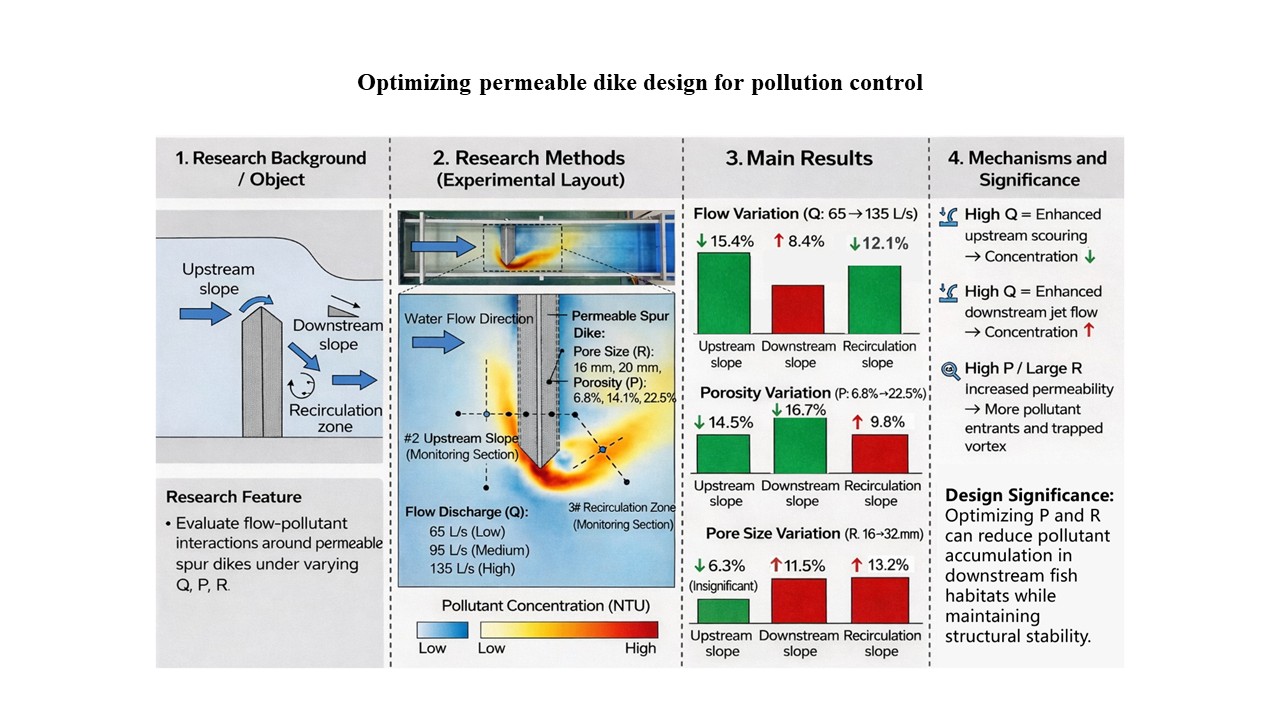
Graphical abstract
Keywords
Permeable spur dike
Porosity
Pore size
Pollutant concentration
Funding
This study is supported by the National Key Research and Development Program of China (Grant No.: 2023YFB2604700) and the Chongqing Natural Science Foundation of China (Grant No. CSTB2023NSCQ-LZX0097).
Conflict of interest
Junhui He and Dejian Wei are employees of Pinglu Canal Group Co., Ltd. However, there is no conflict of interest related to the company regarding the results of this study. The authors declared no potential conflicts of interest with respect to the research, authorship, and publication of this article.
Share
Back to top
Asian Journal of Water, Environment and Pollution, Electronic ISSN: 1875-8568 Print ISSN: 0972-9860, Published by AccScience Publishing