
Nanotechnology-enabled face masks: Balancing protection and pollution in aquatic environments

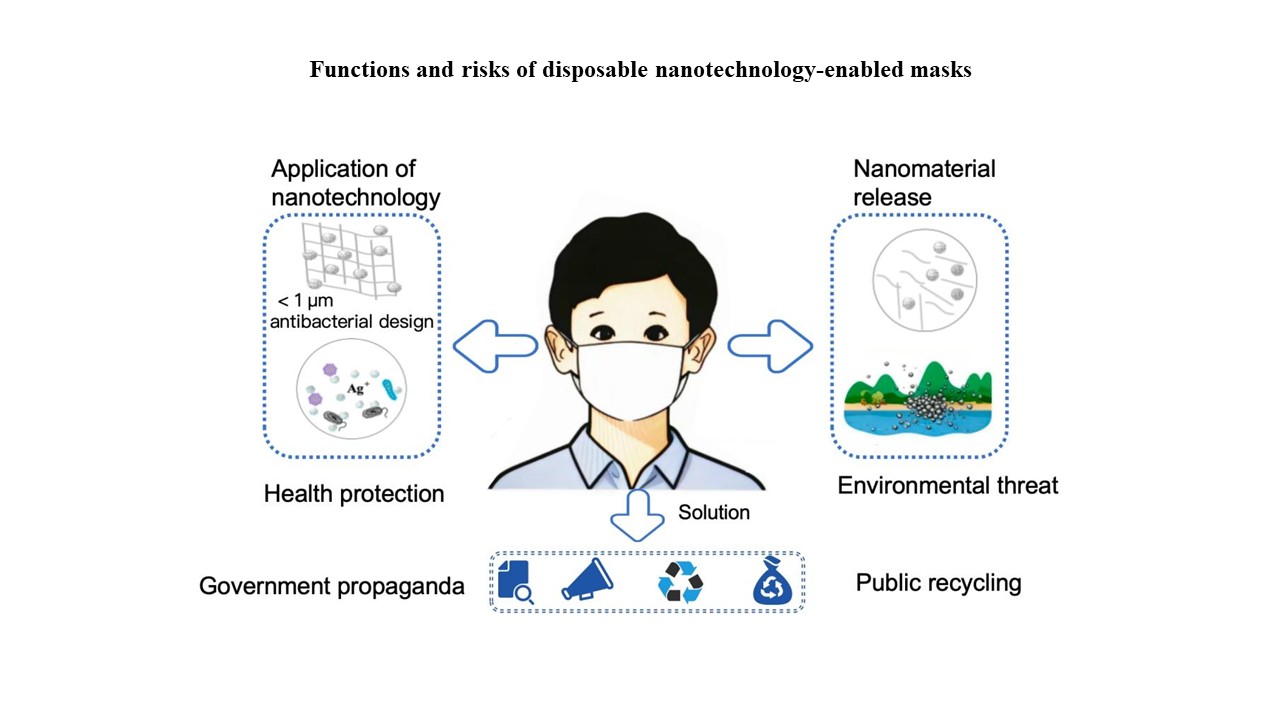
Face masks are widely regarded as essential tools for preventing respiratory infectious diseases, with the incorporation of nanofibers and nanoparticles significantly enhancing their antimicrobial performance. However, the same nanotechnology that strengthens their protective function also introduces complex risks. The extensive use and improper disposal of single-use masks have led to substantial environmental pollution. Discarded masks act as inadvertent conduits, releasing engineered nanomaterials and nanoplastics into wastewater systems through weathering processes. This represents a new and growing source of nanoscale pollution, which may exert cumulative effects on marine organisms and pose potential ecological threats. In light of these concerns, this review systematically assesses the balance between human health benefits and environmental risks associated with nanotechnology-enabled masks in aquatic environments. Furthermore, we explore feasible strategies to address the safety issue, including the development of biodegradable nanomaterials, improved mask designs to reduce emissions, and enhanced end-of-life management. It is crucial to align the application of such advanced masks with a sustainable and acceptable risk–return framework, ensuring that public health advancements do not come at the expense of environmental integrity.
- Darlami HB, Jha AK, Ghimire K. A critical review of recent dewatering technologies: Performance and applications. Asian J Water Environ Pollut. 2025;22(5):55-64. doi: 10.36922/AJWEP025130093
- Liu X, Jin Y, Yin C, et al. Fabrication of microplastic-free biomass-based masks: Enhanced multi-functionality with all-natural fibers. J Hazard Mater. 2025;484:136801. doi: 10.1016/j.jhazmat.2024.136801
- Anene DI, Beltran M, Tjahjono B, et al. Microplastics and chemical additives from disposable face masks: Environmental, human health and behavioural impacts. Sci Total Environ. 2025;973:179079. doi: 10.1016/j.scitotenv.2025.179079
- Shahsavani A, Pasalari H, Kermani M, Tangestani M, Ahmadi F. Health outcomes attributed to inhalation of microplastic released from mask during COVID-19 pandemic: A systematic review. J Hazard Mater Adv. 2025;18:100696. doi: 10.1016/j.hazadv.2025.100696
- Li Q, Ma H, Zhang M, Wei B, Liu D. Synergistic effects of protein coronas and heavy metals on ROS generation: Implications for microplastic-microbe interactions. Int Biodeterior Biodegradation. 2026;207:106225. doi: 10.1016/j.ibiod.2025.106225
- Li M, Guo X, Lan Y, et al. Revealing the neurodevelopmental toxicity of face mask-derived microplastics to humans based on neural organoids. J Hazard Mater. 2025;492:138084. doi: 10.1016/j.jhazmat.2025.138084
- Shen M, Zeng Z, Song B, et al. Neglected microplastics pollution in global COVID-19: Disposable surgical masks. Sci Total Environ. 2021;790:148130. doi: 10.1016/j.scitotenv.2021.148130
- Kteeba SM, Guo L. UV-induced release and characterization of dissolved organic matter from disposable face mask layers and polypropylene. J Hazard Mater. 2025;496:139438. doi: 10.1016/j.jhazmat.2025.139438
- Wang L, Xie L, Li Y, et al. Inorganic additives induce more small-sized microplastics releasing from medical face masks. Environ Sci Technol. 2025;59(18):9188-9198. doi: 10.1021/acs.est.5c01717
- Zhao X, Gao P, Zhao Z, Wu Y, Sun H, Liu C. Microplastics release from face masks: Characteristics, influential factors, and potential risks. Sci Total Environ. 2024;921:171090. doi: 10.1016/j.scitotenv.2024.171090
- Guo J, Sun H, Yuan X, et al. Photocatalytic degradation of persistent organic pollutants by Co-Cl bond reinforced CoAl-LDH/Bi12O17Cl2 photocatalyst: Mechanism and application prospect evaluation. Water Res. 2022;219:118558. doi: 10.1016/j.watres.2022.118558
- Yetisen AK, Qu H, Manbachi A, et al. Nanotechnology in textiles. ACS Nano. 2016;10(3):3042-3068. doi: 10.1021/acsnano.5b08176
- Chua MH, Cheng W, Goh SS, et al. Face masks in the new COVID-19 normal: Materials, testing, and perspectives. Research (Wash D C). 2020;2020:7286735. doi: 10.34133/2020/728673
- Valdiglesias V, Laffon B. The impact of nanotechnology in the current universal COVID-19 crisis. Let’s not forget nanosafety! Nanotoxicology. 2020;14(8):1013-1016. doi: 10.1080/17435390.2020.1780332
- Al-Juthery HWA, Al-Taee RAHG, Alhasan AS, et al. Nano-biofertilizers: A promising technology for sustainable soil fertility, soil health, and environmental protection. Asian J Water Environ Pollut. 2025;22(3):15. doi: 10.36922/AJWEP025160123
- Rudi F, Abu Bakar NK, Mohd Kassim NA, et al. Recent advances in nanomaterials-based adsorbents for organophosphorus contaminant removal in water: An overview. Asian J Water Environ Pollut. 2024;21(1):17-24. doi: 10.3233/AJW240004
- Khan NA, Khan SU, Ahmed S, et al. Applications of nanotechnology in water and wastewater treatment: A review. Asian J Water Environ Pollut. 2019;16(4):81-86. doi: 10.3233/AJW190051
- Liu S, Jin R, Zhang J, Zhao Y, Shen M, Wang Y. Are algae a promising ecofriendly approach to micro/y nanoplastic remediation? Sci Total Environ. 2023;904:166799. doi: 10.1016/j.scitotenv.2023.166779
- Liu S, Zhao Y, Li T, et al. Removal of micro/nanoplastics in constructed wetland: Efficiency, limitations and perspectives. Chem Eng J. 2023;475:146033. doi: 10.1016/j.cej.2023.146033
- Aragaw TA. Surgical face masks as a potential source for microplastic pollution in the COVID-19 scenario. Mar Pollut Bull. 2020;159:111517. doi: 10.1016/j.marpolbul.2020.111517
- Fadare OO, Okoffo ED. Covid-19 face masks: A potential source of microplastic fibers in the environment. Sci Total Environ. 2020;737:140279. doi: 10.1016/j.scitotenv.2020.140279
- Srivastava A, Selvaraj K, Prasad KS. Nanoparticles based adsorbent for removal of arsenic from aqueous solution. Asian J Water Environ Pollut. 2019;16(1):97-103. doi: 10.3233/AJW190011
- Ahmaruzzaman M. Nano-materials: Novel and promising adsorbents for water treatment. Asian J Water Environ Pollut. 2019;16(3):43-53. doi: 10.3233/AJW190032
- Novotna J, Tunak M, Militky J, et al. Release of microplastic fibers from polyester knit fleece during abrasion, washing, and drying. ACS Omega. 2025;10(14):14241-14249. doi: 10.1021/acsomega.5c00258
- Kim J, Kim SW, Waldman WW, et al. Toxicological effects of microplastic fibers from different disposable face masks on Caenorhabditis elegans. Ecotoxicol Environ Saf. 2025;300:118451. doi: 10.1016/j.ecoenv.2025.118451
- Yuan F, Yuan H, Dai C, et al. Study on the process of microplastic fiber attachment to a rising microbubble - Implications for flotation separation. J Environ Chem Eng. 2025;13(3):116819. doi: 10.1016/j.jece.2025.116819
- Malakar A, Snow DD. Nanoparticles as sources of inorganic water pollutants. In: Inorganic Pollutants in Water. Ch. 17. Netherlands: Elsevier; 2020. p. 337-370.doi: 10.1016/B978-0-12-818965-8.00017-2
- Du J, Xing W, Yu J, Feng J, Tang L, Tang W. Synergistic effect of intercalation and EDLC electrosorption of 2D/3D interconnected architectures to boost capacitive deionization for water desalination via MoSe2/mesoporous carbon hollow spheres. Water Res. 2023;235:119831. doi: 10.1016/j.watres.2023.119831
- Huang X, Auffan M, Eckelman MJ, et al. Trends, risks and opportunities in environmental nanotechnology. Nat Rev Earth Environ. 2024;5(8):572-587.
- Wang D, Pan Q, Yang J, Gong S, Liu X, Fu Y. Effects of mixtures of engineered nanoparticles and cocontaminants on anaerobic digestion. Environ Sci Technol. 2024;58(6):2598-2614. doi: 10.1021/acs.est.3c09239
- Wang P, Xiang Q, Fu Z, et al. Silver nanoparticles alter plankton-mediated carbon cycle processes in freshwater mesocosms. J Hazard Mater. 2025;492:138279. doi: 10.1016/j.jhazmat.2025.138279
- Naguib M, Mahmoud UM, Mekkawy IA, Sayed AEH. Hepatotoxic effects of silver nanoparticles on Clarias gariepinus; biochemical, histopathological, and histochemical studies. Toxicol Rep. 2020;7:133-141. doi: 10.1016/j.toxrep.2020.01.002
- Zhang H, Jiang L, Wang H, et al. Evaluating the remediation potential of MgFe2O4-montmorillonite and its co-application with biochar on heavy metal-contaminated soils. Chemosphere. 2022;299:134217. doi: 10.1016/j.chemosphere.2022.134217
- Wang T, Santos JP, Slaveykova VI, Stoll S, Liu W. From microalgae to gastropods: Understanding the kinetics and toxicity of silver nanoparticles in freshwater aquatic environment. Environ Pollut. 2025;367:125643. doi: 10.1016/j.envpol.2025.125643
- Zhao X, Liang J, Li Y, et al. Trophic transfer of metal nanoparticles in an aquatic food chain diminishes their toxicity disparities. Environ Sci Technol. 2025;59(13):6812-6824. doi: 10.1021/acs.est.4c13148
- He G, Shu S, Liu G, et al. Aquatic macrophytes mitigate the short-term negative effects of silver nanoparticles on denitrification and greenhouse gas emissions in riparian soils. Environ Pollut. 2022;293:118611. doi: 10.1016/j.envpol.2021.118611
- Chiu NF, Tai MJ, Lin JC, Nurrohman DT, Ku TH. Enhanced detection of SARS-CoV-2 spike protein using nitrogen-doped graphene quantum dot-based SPR biosensors. NPJ Biosens. 2025;2(1):28. doi: 10.1038/s44328-025-00046-x
- Martins G, Galvan ALS, Valenga MGP, Martins TAC, Bergamini MF, Marcolino-Junior LH. Nitrogen-doped graphene quantum dots (N-GQDs): A promising material for the development of electrochemical immunosensors. ACS Appl Nano Mater. 2025;8(12):5908-5918. doi: 10.1021/acsanm.4c06568
- Weng RJ, Wu LS, Kurniawan D, et al. Plasma-guided green synthesis of crystalline graphene quantum dots for broad-spectrum antiviral applications. Chem Eng J. 2025;524:169080. doi: 10.1016/j.cej.2025.169080
- Jung Y, Hwang J, Cho H, et al. Graphene quantum dots as potential broad-spectrum antiviral agents. Nanoscale Adv. 2025;7(7):2032-2038. doi: 10.1039/D4NA00879K
- Saeed M, Altamash M, Almoyad MAA, et al. Transferrin-guided liposomal nanocarriers: A strategy for targeted cancer treatment. Int J Biol Macromol. 2025;319:145377. doi: 10.1016/j.ijbiomac.2025.145377
- Gundersen ET, Wang Z, Førde JL, et al. Repurposing chlorpromazine for anti-leukaemic therapy with the drug-in-cyclodextrin-in-liposome nanocarrier platform. Carbohydr Polym. 2025;358:123478. doi: 10.1016/j.carbpol.2025.123478
- Conlon T, Schaaf M, Mateos-Maroto A, et al. Comparative effects of extracellular vesicles and liposomal nanocarriers on bleomycin-induced stress in A549 human adenocarcinoma cells. Biomed Pharmacother. 2025;187:118081. doi: 10.1016/j.biopha.2025.118081
- Shaw I, Aryee AA, Ali YS, et al. Harmonizing tradition and technology: Liposomal nanocarriers unlocking the power of natural herbs in Traditional Chinese Medicine. Chin J Nat Med. 2025;23(6):700-713. doi: 10.1016/S1875-5364(25)60889-2
- Degang T, Wei X, Jianying S, et al. Advancements in nanoparticles-based therapeutic approaches for osteosarcoma: Insights from catechins-modified selenium-doped hydroxyapatite: A review. Medicine (Baltimore). 2025;104(7):e41489. doi: 10.1097/MD.0000000000041489
- Kotharkar P, Talukdar I, Ramanan SR, Ramesh K, Shastry A, Kowshik M. Hydroxyapatite nanoparticle mediated delivery of full length dystrophin gene as a potential therapeutic for the treatment of Duchenne muscular dystrophy. Nanoscale. 2025;17(4):2078-2090. doi: 10.1039/D4NR03906H
- Zhou Y, Feng C, Yang X, et al. Capillary force-driven capture of magnetic nanoparticles in calcium phosphate hollow-tube whisker scaffolds for osteonecrosis of the femoral head. ACS Nano. 2025;19(22):20779-20798. doi: 10.1021/acsnano.5c02874
- Garkal A, Hariharan K, Mehta T. Nanotechnology in battle against coronavirus. Nirma Univ J Pharm Sci. 2020;7:67-76.
- Palmieri V, De Maio F, De Spirito M, Papi M. Face masks and nanotechnology: Keep the blue side up. Nano Today. 2021;37:101077. doi: 10.1016/j.nantod.2021.101077
- Tcharkhtchi A, Abbasnezhad N, Seydani MZ, Zirak N, Farzaneh S, Shirinbayan M. An overview of filtration efficiency through the masks: Mechanisms of the aerosols penetration. Bioactive Mater. 2021;6(1):106-122. doi: 10.1016/j.bioactmat.2020.08.002
- Sang F, Yin Z, Wang W, et al. Degradation of ciprofloxacin using heterogeneous Fenton catalysts derived from natural pyrite and rice straw biochar. J Clean Prod. 2022;378:134459. doi: 10.1016/j.jclepro.2022.134459
- Bhattacharjee S, Joshi R, Chughtai AA, Macintyre CR. Graphene modified multifunctional personal protective clothing. Adv Mater Interfaces. 2019;6(21):1900622. doi: 10.1002/admi.201900622
- Li Y, Leung P, Yao L, Song QW, Newton E. Antimicrobial effect of surgical masks coated with nanoparticles. J Hosp Infect. 2006;62(1):58-63. doi: 10.1016/j.jhin.2005.04.015
- Yang Y, Guo Z, Huang W, et al. Fabrication of multifunctional textiles with durable antibacterial property and efficient oil-water separation via in situ growth of zeolitic imidazolate framework-8 (ZIF-8) on cotton fabric. Appl Surf Sci. 2020;503:144079. doi: 10.1016/j.apsusc.2019.144079
- Kumar A, Sharma A, Chen Y, et al. Copper@ ZIF‐8 core‐shell nanowires for reusable antimicrobial face masks. Adv Funct Mater. 2021;31(10):2008054. doi: 10.1002/adfm.202008054
- Li TT, Fan Y, Cen X, et al. Polypropylene/polyvinyl alcohol/metal-organic framework-based melt-blown electrospun composite membranes for highly efficient filtration of PM2.5. Nanomaterials (Basel). 2020;10(10):2025. doi: 10.3390/nano10102025
- Han D, Li Y, Liu X, et al. Rapid bacteria trapping and killing of metal-organic frameworks strengthened photo-responsive hydrogel for rapid tissue repair of bacterial infected wounds. Chem Eng J. 2020;396:125194. doi: 10.1016/j.cej.2020.125194
- Han D, Li Y, Liu X, et al. Photothermy-strengthened photocatalytic activity of polydopamine-modified metal-organic frameworks for rapid therapy of bacteria-infected wounds. J Mater Sci Technol. 2021;62:83-95. doi: 10.1016/j.jmst.2020.05.055
- Adamcakova-Dodd A, Monick MM, Powers LS, et al. Effects of prenatal inhalation exposure to copper nanoparticles on murine dams and offspring. Part Fibre Toxicol. 2015;12(1):30. doi: 10.1186/s12989-015-0105-5
- Baker TJ, Tyler CR, Galloway TS. Impacts of metal and metal oxide nanoparticles on marine organisms. Environ Pollut. 2014;186:257-271. doi: 10.1016/j.envpol.2013.11.014
- Li DTS, Samaranayake LP, Leung YY, Neelakantan P. Facial protection in the era of COVID‐19: A narrative review. Oral Dis. 2021;27:665-673. doi: 10.1111/odi.13460
- Luo Z, Li Z, Xie Z, et al. Rethinking nano‐TiO2 safety: Overview of toxic effects in humans and aquatic animals. Small. 2020;16(36):2002019. doi: 10.1002/smll.202002019
- Fusco L, Garrido M, Martín C, et al. Skin irritation potential of graphene-based materials using a non-animal test. Nanoscale. 2020;12(2):610-622. doi: 10.1039/C9NR06815E
- Xu EG, Ren ZJ. Preventing masks from becoming the next plastic problem. Front Environ Sci Eng. 2021;15(6):125. doi: 10.1007/s11783-021-1413-7
- Zhu X, Zhao W, Chen X, et al. Growth inhibition of the microalgae Skeletonema costatum under copper nanoparticles with microplastic exposure. Mar Environ Res. 2020;158:105005. doi: 10.1016/j.marenvres.2020.105005
- Gunasekaran D, Chandrasekaran N, Jenkins D, Mukherjee A. Plain polystyrene microplastics reduce the toxic effects of ZnO particles on marine microalgae Dunaliella salina. J Environ Chem Eng. 2020;8(5):104250. doi: 10.1016/j.jece.2020.104250
- Li P, Zou X, Wang X, et al. A preliminary study of the interactions between microplastics and citrate-coated silver nanoparticles in aquatic environments. J Hazard Mater. 2020;385:121601. doi: 10.1016/j.jhazmat.2019.121601
- Dong S, Qu M, Rui Q, Wang D. Combinational effect of titanium dioxide nanoparticles and nanopolystyrene particles at environmentally relevant concentrations on nematode Caenorhabditis elegans. Ecotoxicol Environ Saf. 2018;161:444-450. doi: 10.1016/j.ecoenv.2018.06.021
- Oliveira MLS, Saikia BK, da Boit K, Pinto D, Tutikian BF, Silva LFO. River dynamics and nanopaticles formation: A comprehensive study on the nanoparticle geochemistry of suspended sediments in the Magdalena River, Caribbean Industrial Area. J Clean Prod. 2019;213:819-824. doi: 10.1016/j.jclepro.2018.12.230
- Shen M, Zhang Y, Zhu Y, et al. Recent advances in toxicological research of nanoplastics in the environment: A review. Environ Pollut. 2019;252:511-521. doi: 10.1016/j.envpol.2019.05.102
- Prata JC, Silva ALP, Walker TR, Duarte AC, Rocha- Santos T. COVID-19 pandemic repercussions on the use and management of plastics. Environ Sci Technol. 2020;54(13):7760-7765. doi: 10.1021/acs.est.0c02178
- Sullivan GL, Delgado-Gallardo J, Watson TM, et al. An investigation into the leaching of micro and nano particles and chemical pollutants from disposable face masks-linked to the COVID-19 pandemic. Water Res. 2021;196:117033. doi: 10.1016/j.watres.2021.117033