

Analysis of rain-induced underground debris flow events in mines based on logistic regression models

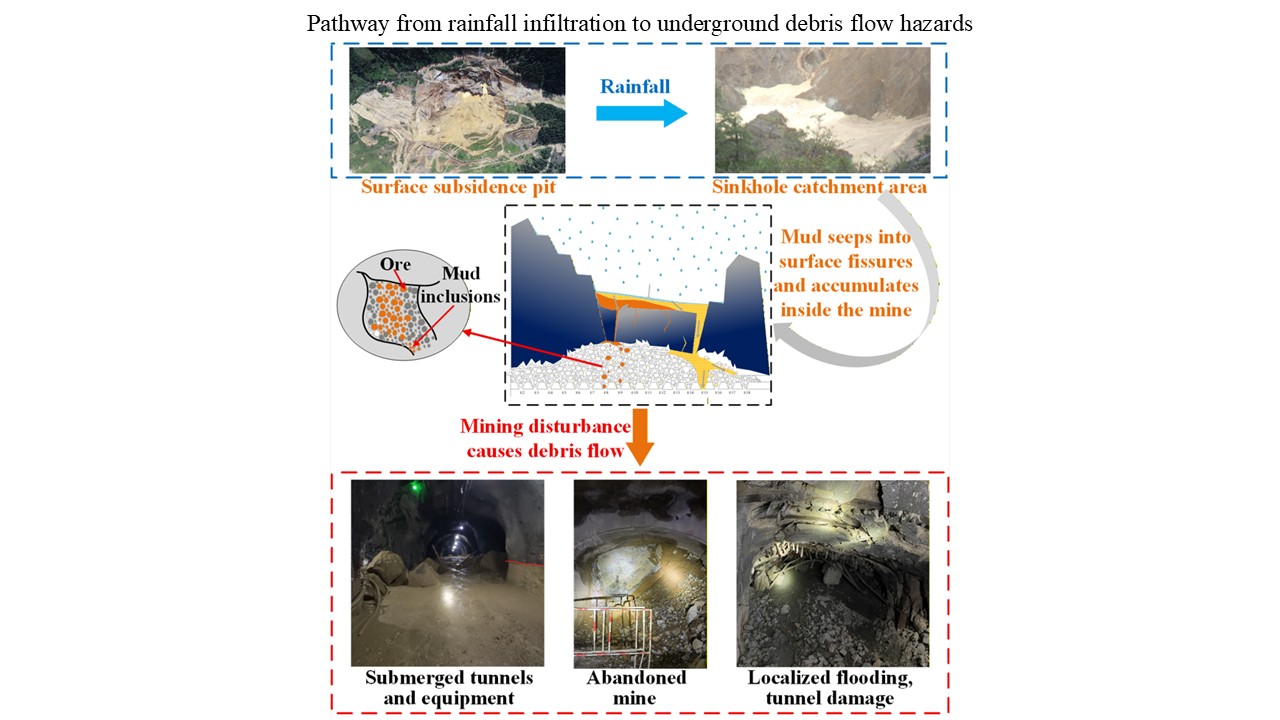
Rainfall is one of the main external factors triggering debris flows in mines. To investigate the relationship between rainfall and the occurrence of underground debris flows, we selected 249 rainfall events in the study area from 2020 to 2022, including 86 potential underground debris flow events and five large-scale underground debris flow events. A rainfall threshold model for the occurrence of underground debris flows was developed using logistic regression. The model’s accuracy, area under the receiver operating characteristic curve, and F1 score were 0.85, 0.9493, and 0.85, respectively, indicating good predictive performance and generalization. The results show that the rainfall thresholds for underground debris flow occurrence can be classified into three risk levels: (i) for p=0.9, the triggering rainfall was 88.6483 mm and the antecedent effective rainfall was 164.9885 mm; (ii) for p=0.7, the triggering rainfall was 78.2563 mm and the antecedent effective rainfall was 145.6473 mm; and (iii) for p=0.5, the triggering rainfall was 71.7336 mm and the antecedent effective rainfall was 133.5076 mm. The research findings provide a theoretical basis for the prevention and control of debris flow events in mines.
- Niu X, Zhe Y, Sun H, Hou K, Jiang J. Study on the effect of ore-drawing shear factor on underground debris flow in the block caving method. Water. 2023;15(20):3563. doi: 10.3390/w15203563
- Tuo R, Cheng H, Wu S, et al. Impact of the source material gradation on the disaster mechanism of underground debris flows in mines. Sustainability. 2024;16(20):8788. doi: 10.3390/su16208788
- Zhang Y, He K, Hu X, et al. Integrated geophysical and computational modeling of hydromechanical mechanisms of underground debris flows in mining region. Undergr Space. 2025;25:33-53. doi: 10.1016/j.undsp.2025.06.002
- Castro R, Perez Á, Gomez R. Evaluating wet muck risk in block caving mines: A new model. Int J Rock Mech Mining Sci. 2023;170:105485. doi: 10.1016/j.ijrmms.2023.105485
- Xinlong F, Zhengrong L, Aixiang W, et al. Risk assessment and prevention of underground debris flow in mine based on combination weighting-matter element exten-sion model. Mining Res Dev. 2025;44(9): 158-166.
- Cabral V, Gomes Vieira Reis FA, Queiros Veloso V, Costa Basilio T, Dos Santos Corrêa CV, Zarfl C. The dynamics of debris-flow events in Southeast Brazil. J S Am Earth Sci. 2025;159:105523. doi: 10.1016/j.jsames.2025.105523
- He K, Xi C, Liu B, et al. MPM-based mechanism and runout analysis of a compound reactivated landslide. Comput Geotech. 2023;159:105455. doi: 10.1016/j.compgeo.2023.105455
- Ye ZM, Xu ZM, Li B, et al. Generation and origin of persistent high excess pore water pressure in debris flows. Geomorphology. 2024;444:108954. doi: 10.1016/j.geomorph.2023.108954
- Zhang Y, He K, Hu X, et al. Mechanism of surface subsidence and sinkhole formation in mining areas: Insights from MPM. Bull Eng Geol Environ. 2024;83(8):330. doi: 10.1007/s10064-024-03822-7
- Palumbo M, Ascione A, Santo A, Santangelo N. Evaluation of sediment budgets in catchments prone to flash flood-related debris flows: A case study from the southern Apennines (Italy). Geomorphology. 2024;454:109174. doi: 10.1016/j.geomorph.2024.109174
- LlU H, Xu H, Bao H, Xu W, Yan X, Xu C. Characteristics Analysis of Rainfall-Induced Landslide Thresholds in Local Regions. J Natural Disasters. 2021,30(4):181-190. doi: 10.13577/j.jnd.2021.0420
- Simoni A, Bernard M, Berti M, et al. Runoff-generated debris flows: Observation of initiation conditions and erosion-deposition dynamics along the channel at Cancia (eastern Italian Alps). Earth Surf Process Landform. 2020;45(14):3556-3571. doi: 10.1002/esp.4981
- Zhao Y, Meng X, Qi T, et al. AI-based rainfall prediction model for debris flows. Eng Geol. 2022;296:106456. doi: 10.1016/j.enggeo.2021.106456
- Sutton JR. An inquiry into the origin of the mud rushes in the de beer’s mine, Kimberley; Covering the period January 1, 1894, to December 31, 1896. Trans S Afr Philosop Soc. 1895;9(2):54-67. doi: 10.1080/21560382.1895.9526316
- Niu X, Hou K, Bao G, Zhe Y. Study on formation mechanism of mud-inclusion-type underground debris flows using natural caving method. Sci Rep. 2024;14(1):4324. doi: 10.1038/s41598-024-54082-0
- Huang X, Wang T, Xu Z, et al. Experimental study on the mechanism of intermittent water and mud inrush caused by dredging and rainfall considering sedimentary characteristics in karst tunnels. KSCE J Civil Eng. 2023;27(5):2016-2029. doi: 10.1007/s12205-023-1837-7
- Chen B, Zhang S, Li Y, Li J. Experimental study on water and sand inrush of mining cracks in loose layers with different clay contents. Bull Eng Geol Environ. 2021;80(1):663-678. doi: 10.1007/s10064-020-01941-5
- Zhao Y, Zhang L. Experimental study on the mud-water inrush characteristics through rock fractures. Adv Civil Eng. 2018;2018(1):2060974. doi: 10.1155/2018/2060974
- Zhang J, Cheng H, Wu S, et al. Risk analysis of underground debris flows in mines based on a coupled weighted Bayesian network. Int J Disaster Risk Reduct. 2024;114:104922. doi: 10.1016/j.ijdrr.2024.104922
- Zhang J, Feng X, Wu A, et al. Critical early warning of underground debris flows in mines based on rainfall-collapse characteristics. Nat Hazards. 2025;121(1):423-445. doi: 10.1007/s11069-024-06829-1
- Castro R, Garcés D, Brzovic A, Armijo F. Quantifying wet muck entry risk for long-term planning in block caving. Rock Mech Rock Eng. 2018;51(9):2965-2978. doi: 10.1007/s00603-018-1512-3
- Xue Y, Kong F, Li S, et al. Water and mud inrush hazard in underground engineering: Genesis, evolution and prevention. Tunnell Undergr Space Technol. 2021;114:103987. doi: 10.1016/j.tust.2021.103987
- Aleotti P. A warning system for rainfall-induced shallow failures. Eng Geol. 2004;73(3):247-265. doi: 10.1016/j.enggeo.2004.01.007
- Liu H, Ma Z, Fan G. Relationship between landslide/ debris flow and rainfall in typical region of Sichuan province. BSWC. 2016;36(6):73-77. doi: 10.13961/j.cnki.stbctb.2016.06.013
- Khan MA, Mustaffa Z, Harahap ISH, Ibrahim MB, Al-Atroush ME. Assessment of physical vulnerability and uncertainties for debris flow hazard: A review concerning climate change. Land. 2022;11(12):2240. doi: 10.3390/land11122240
- Shuhua Z, Mao J, GA0 Q, et al. Rainfall infiltration and attenuation regularity analysis of debris flow loose material under different rainfall pattern. 2019;50(7):22-27. doi: 10.16232/j.cnki.1001-4179.2019.07.004
- Xie J, Liu L, Ying K, Du H. Research on rainfall threshold for landslide disaster early warning and forecasting in Zhejiang Province. 2003;22(4):101-105.
- Alene GH, Vicari H, Irshad S, Perkis A, Bruland O, Thakur V. Realistic visualization of debris flow type landslides through virtual reality. Landslides. 2023;20(1):13-23. doi: 10.1007/s10346-022-01948-x
- Wang L, Chang M, Le J, Xiang L, Ni Z. Two multi-temporal datasets to track debris flow after the 2008 Wenchuan earthquake. Sci Data. 2022;9(1):525. doi: 10.1038/s41597-022-01658-y
- Shengdong L, Qiang L, Fen L, et al. Study on threshold and damage of landslide disaster induced by atmospheric precipitation in loess plateau. Zaihaixue. 2023;38(3):53-59.
- Yifan S, Yuanyao LI, Yong XU, Jiming WU, Wei LIN. Prediction of rainfall-type landslides based on effective rainfall intensity and logistic regression. Swdzgcdz. 2019;46(1):156-162. doi: 10.16030/j.cnki.issn.1000-3665.2019.01.21
- Wei L, Yuanyao L, Yong X, Zhipeng L, Ying C, Yifan S. Rainfall thresholds of rainfall-triggered landslides in Cili County, Hunan Province. Chang Kexuey Yuanbao. 2020;37(2):48-54.
- Lei H, Yugan H, Peng S, Qiang Z, Qiang Z, Jian C. A quantitative analysis of disaster threshold and landslide risk of rainfall-type landslide in Southeast Tibet. Zaihaixue. 2021;36(4):194-199. doi: 10.3969/j.issn.2021.04.032
- Glade T, Crozier M, Smith P. Applying probability determination to refine landslide-triggering rainfall thresholds using an empirical “antecedent daily rainfall model.” Pure Appl Geophys. 2000;157(6):1059-1079. doi: 10.1007/s000240050017
- Weiqing C, Mao P, Li T, Ren Q, Li R. Quantitative analysis of critical rainfall-triggereddebris flows. Chin J Rock Mech Eng. 25(S1):2808-2808.
- Guo XJ, Cui P, Li Y. Debris flow warning threshold based on antecedent rainfall: A case study in Jiangjia Ravine, Yunnan, China. J Mt Sci. 2013;10(2):305-314. doi: 10.1007/s11629-013-2521-z
- Zhuang J, Cui P, Wang G, Chen X, Iqbal J, Guo X. Rainfall thresholds for the occurrence of debris flows in the Jiangjia Gully, Yunnan Province, China. Eng Geol. 2015;195:335-346. doi: 10.1016/j.enggeo.2015.06.006
- Ahmed A, Jalal A, Kim K. A novel statistical method for scene classification based on multi-object categorization and logistic regression. Sensors (Basel). 2020;20(14):3871. doi: 10.3390/s20143871
- Luguang LUO, Xiangjun PEI, Runqiu H, Zuan PEI, Ling ZHU. Landslide susceptibility assessment in jiuzhaigou scenic area with gis based on certainty factor and logistic regression model. J Eng Geol. 2021;29(2):526-535. doi: 10.13544/j.cnki.jeg.2019-202
- Xu W, Yu W, Zhang G. Prediction method of debris flow by logistic model with two types of rainfall: A case study in the Sichuan, China. Nat Hazards. 2012;62(2):733-744. doi: 10.1007/s11069-011-9988-0