
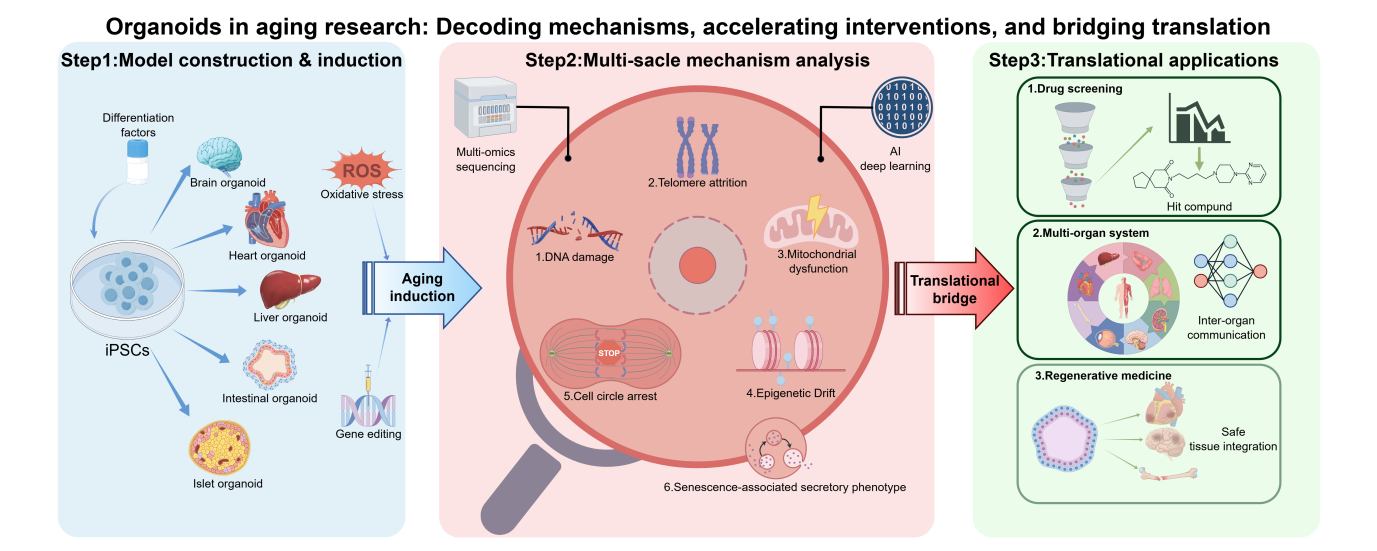
Organoids in aging research: Decoding mechanisms, accelerating interventions, and bridging translation

Aging, as a process of gradual decline in cellular and tissue function, poses a major challenge for healthcare systems worldwide. However, traditional models (experimental animals and 2D cell cultures) struggle to reproduce the complexity of human aging, which limits the depth of mechanistic understanding. Organoids, defined as self-organizing 3D stem cell-derived structures that replicate key organ features, have effectively addressed this research gap. This article reviews the applications of organoids in the study of aging, including their core principles, methods for generating common organoid types, advantages, and limitations. The validation processes and mechanisms of the aging model are also discussed. In addition, the applications of brain organoids in research on Alzheimer’s disease and Parkinson’s disease, heart organoids in research on myocardial aging, and liver and islet organoids in research on diabetes are emphasized. Despite advances in single-cell sequencing, gene editing, and imaging technologies, challenges such as standardization and vascularization remain. Nevertheless, organoids have accelerated the development of anti-aging drugs and personalized medicine, thus becoming indispensable tools for understanding the mechanisms of human aging and developing interventions to extend healthy life span.
- Bautmans I, Knoop V, Amuthavalli Thiyagarajan J, et al. WHO working definition of vitality capacity for healthy longevity monitoring. Lancet Healthy Longev. 2022;3(11):e789-e796. doi: 10.1016/s2666-7568(22)00200-8
- Venkatapuram S, Amuthavalli Thiyagarajan J. The capability approach and the WHO healthy ageing framework (for the UN Decade of Healthy Ageing). Age Ageing. 2023;52(Suppl 4):iv6-iv9. doi: 10.1093/ageing/afad126
- Beard JR, Officer A, de Carvalho IA, et al. The World report on ageing and health: A policy framework for healthy ageing. Lancet. 2016;387(10033):2145-2154. doi: 10.1016/s0140-6736(15)00516-4
- Partridge L, Deelen J, Slagboom PE. Facing up to the global challenges of ageing. Nature. 2018;561(7721):45-56. doi: 10.1038/s41586-018-0457-8
- Barnes PJ. Mechanisms of development of multimorbidity in the elderly. Eur Respir J. 2015;45(3):790-806. doi: 10.1183/09031936.00229714
- Fratiglioni L, Marseglia A, Dekhtyar S. Ageing without dementia: Can stimulating psychosocial and lifestyle experiences make a difference? Lancet Neurol. 2020;19(6): 533-543. doi: 10.1016/s1474-4422(20)30039-9
- Borghesan M, Hoogaars WMH, Varela-Eirin M, Talma N, Demaria M. A senescence-centric view of aging: Implications for longevity and disease. Trends Cell Biol. 2020;30(10): 777-791. doi: 10.1016/j.tcb.2020.07.002
- Ambrose JA, Barua RS. The pathophysiology of cigarette smoking and cardiovascular disease: an update. J Am Coll Cardiol. 2004;43(10):1731-1737. doi: 10.1016/j.jacc.2003.12.047
- Crnko S, Du Pré BC, Sluijter JPG, Van Laake LW. Circadian rhythms and the molecular clock in cardiovascular biology and disease. Nat Rev Cardiol. 2019;16(7):437-447. doi: 10.1038/s41569-019-0167-4
- Hu C. Prevention of cardiovascular disease for healthy aging and longevity: A new scoring system and related “mechanisms-hallmarks-biomarkers”. Ageing Res Rev. 2025;107:102727. doi: 10.1016/j.arr.2025.102727
- Cosco TD, Howse K, Brayne C. Healthy ageing, resilience and wellbeing. Epidemiol Psychiatr Sci. 2017;26(6):579-583. doi: 10.1017/s2045796017000324
- Campisi J, Kapahi P, Lithgow GJ, Melov S, Newman JC, Verdin E. From discoveries in ageing research to therapeutics for healthy ageing. Nature. 2019;571(7764):183-192. doi: 10.1038/s41586-019-1365-2
- Rossi G, Manfrin A, Lutolf MP. Progress and potential in organoid research. Nat Rev Genet. 2018;19(11):671-687. doi: 10.1038/s41576-018-0051-9
- Garreta E, Kamm RD, Chuva de Sousa Lopes SM, et al. Rethinking organoid technology through bioengineering. Nat Mater. 2021;20(2):145-155. doi: 10.1038/s41563-020-00804-4
- Watanabe S, Kobayashi S, Ogasawara N, et al. Transplantation of intestinal organoids into a mouse model of colitis. Nat Protoc. 2022;17(3):649-671. doi: 10.1038/s41596-021-00658-3
- Fujii M, Matano M, Toshimitsu K, et al. Human intestinal organoids maintain self-renewal capacity and cellular diversity in niche-inspired culture condition. Cell Stem Cell. 2018;23(6):787-793.e6. doi: 10.1016/j.stem.2018.11.016
- Xiang T, Wang J, Li H. Current applications of intestinal organoids: A review. Stem Cell Res Ther. 2024;15(1):155. doi: 10.1186/s13287-024-03768-3
- Prior N, Inacio P, Huch M. Liver organoids: From basic research to therapeutic applications. Gut. 2019;68(12): 2228-2237. doi: 10.1136/gutjnl-2019-319256
- Afonso MB, Marques V, van Mil SWC, Rodrigues CMP. Human liver organoids: From generation to applications. Hepatology. 2024;79(6):1432-1451. doi: 10.1097/hep.0000000000000343
- Lee SH, Hu W, Matulay JT, et al. Tumor evolution and drug response in patient-derived organoid models of bladder cancer. Cell. 2018;173(2):515-528.e17. doi: 10.1016/j.cell.2018.03.017
- Zhao Y, Li S, Zhu L, et al. Personalized drug screening using patient-derived organoid and its clinical relevance in gastric cancer. Cell Rep Med. 2024;5(7):101627. doi: 10.1016/j.xcrm.2024.101627
- Pasch CA, Favreau PF, Yueh AE, et al. Patient-derived cancer organoid cultures to predict sensitivity to chemotherapy and radiation. Clin Cancer Res. 2019;25(17):5376-5387. doi: 10.1158/1078-0432.Ccr-18-3590
- Boretto M, Maenhoudt N, Luo X, et al. Patient-derived organoids from endometrial disease capture clinical heterogeneity and are amenable to drug screening. Nat Cell Biol. 2019;21(8):1041-1051. doi: 10.1038/s41556-019-0360-z
- Millen R, De Kort WWB, Koomen M, et al. Patient-derived head and neck cancer organoids allow treatment stratification and serve as a tool for biomarker validation and identification. Med. 2023;4(5):290-310.e12. doi: 10.1016/j.medj.2023.04.003
- Zhou S, Li Z, Li X, et al. Crosstalk between endothelial cells and dermal papilla entails hair regeneration and angiogenesis during aging. J Adv Res. 2025;70:339-353. doi: 10.1016/j.jare.2024.05.006
- Tao Y, Kang B, Petkovich DA, et al. Aging-like spontaneous epigenetic silencing facilitates wnt activation, stemness, and Braf(V600E)-induced tumorigenesis. Cancer Cell. 2019;35(2):315-328.e6. doi: 10.1016/j.ccell.2019.01.005
- Lancaster MA, Renner M, Martin CA, et al. Cerebral organoids model human brain development and microcephaly. Nature. 2013;501(7467):373-379. doi: 10.1038/nature12517
- Trujillo CA, Muotri AR. Brain organoids and the study of neurodevelopment. Trends Mol Med. 2018;24(12):982-990. doi: 10.1016/j.molmed.2018.09.005
- Velasco S, Kedaigle AJ, Simmons SK, et al. Individual brain organoids reproducibly form cell diversity of the human cerebral cortex. Nature. 2019;570(7762):523-527. doi: 10.1038/s41586-019-1289-x
- Sidhaye J, Knoblich JA. Brain organoids: An ensemble of bioassays to investigate human neurodevelopment and disease. Cell Death Differ. 2021;28(1):52-67. doi: 10.1038/s41418-020-0566-4
- Birtele M, Lancaster M, Quadrato G. Modelling human brain development and disease with organoids. Nat Rev Mol Cell Biol. 2025;26(5):389-412. doi: 10.1038/s41580-024-00804-1
- Sachs N, Papaspyropoulos A, Zomer-van Ommen DD, et al. Long-term expanding human airway organoids for disease modeling. Embo J. 2019;38(4):e100300. doi: 10.15252/embj.2018100300
- Li W, Wu T, Zhu K, et al. A single-cell transcriptomic census of mammalian olfactory epithelium aging. Dev Cell. 2024;59(22):3043-3058.e8. doi: 10.1016/j.devcel.2024.07.020
- Hendriks D, Artegiani B, Hu H, Chuva de Sousa Lopes S, Clevers H. Establishment of human fetal hepatocyte organoids and CRISPR-Cas9-based gene knockin and knockout in organoid cultures from human liver. Nat Protoc. 2021;16(1):182-217. doi: 10.1038/s41596-020-00411-2
- Broutier L, Andersson-Rolf A, Hindley CJ, et al. Culture and establishment of self-renewing human and mouse adult liver and pancreas 3D organoids and their genetic manipulation. Nat Protoc. 2016;11(9):1724-1743. doi: 10.1038/nprot.2016.097
- Yu T, Yang Q, Peng B, Gu Z, Zhu D. Vascularized organoid-on-a-chip: Design, imaging, and analysis. Angiogenesis. 2024;27(2):147-172. doi: 10.1007/s10456-024-09905-z
- Jin J. Stem cell treatments. JAMA. 2017;317(3):330. doi: 10.1001/jama.2016.17822
- Lancaster MA, Knoblich JA. Organogenesis in a dish: Modeling development and disease using organoid technologies. Science. 2014;345(6194):1247125. doi: 10.1126/science.1247125
- Dutta D, Heo I, Clevers H. Disease modeling in stem cell-derived 3D organoid systems. Trends Mol Med. 2017;23(5):393-410. doi: 10.1016/j.molmed.2017.02.007
- Clevers H. Modeling development and disease with organoids. Cell. 2016;165(7):1586-1597. doi: 10.1016/j.cell.2016.05.082
- Tang XY, Wu S, Wang D, et al. Human organoids in basic research and clinical applications. Signal Transduct Target Ther. 2022;7(1):168. doi: 10.1038/s41392-022-01024-9
- Yan KS, Janda CY, Chang J, et al. Non-equivalence of Wnt and R-spondin ligands during Lgr5(+) intestinal stem-cell self-renewal. Nature. 2017;545(7653):238-242. doi: 10.1038/nature22313
- van de Wetering M, Francies HE, Francis JM, et al. Prospective derivation of a living organoid biobank of colorectal cancer patients. Cell. 2015;161(4):933-945. doi: 10.1016/j.cell.2015.03.053
- Yin X, Farin HF, van Es JH, Clevers H, Langer R, Karp JM. Niche-independent high-purity cultures of Lgr5+ intestinal stem cells and their progeny. Nat Methods. 2014;11(1): 106-112. doi: 10.1038/nmeth.2737
- Lin Y, Fang ZP, Liu HJ, et al. HGF/R-spondin1 rescues liver dysfunction through the induction of Lgr5(+) liver stem cells. Nat Commun. 2017;8(1):1175. doi: 10.1038/s41467-017-01341-6
- Torizal FG, Utami T, Lau QY, Inamura K, Nishikawa M, Sakai Y. Dialysis based-culture medium conditioning improved the generation of human induced pluripotent stem cell derived-liver organoid in a high cell density. Sci Rep. 2022;12(1):20774. doi: 10.1038/s41598-022-25325-9
- Verstegen MMA, Coppes RP, Beghin A, et al. Clinical applications of human organoids. Nat Med. 2025;31(2): 409-421. doi: 10.1038/s41591-024-03489-3
- Xu J, Fang S, Deng S, et al. Generation of neural organoids for spinal-cord regeneration via the direct reprogramming of human astrocytes. Nat Biomed Eng. 2023;7(3):253-269. doi: 10.1038/s41551-022-00963-6
- Wu S, Hong Y, Chu C, et al. Construction of human 3D striato-nigral assembloids to recapitulate medium spiny neuronal projection defects in Huntington’s disease. Proc Natl Acad Sci U S A. 2024;121(22):e2316176121. doi: 10.1073/pnas.2316176121
- Lim B, Matsui Y, Jung S, et al. Phosphorylation of the DNA damage repair factor 53BP1 by ATM kinase controls neurodevelopmental programs in cortical brain organoids. PLoS Biol. 2024;22(9):e3002760. doi: 10.1371/journal.pbio.3002760
- Hildebrandt MR, Reuter MS, Wei W, et al. Precision health resource of control iPSC lines for versatile multilineage differentiation. Stem Cell Rep. 2019;13(6):1126-1141. doi: 10.1016/j.stemcr.2019.11.003
- Rossi G, Broguiere N, Miyamoto M, et al. Capturing cardiogenesis in gastruloids. Cell Stem Cell. 2021;28(2): 230-240.e6. doi: 10.1016/j.stem.2020.10.013
- Zhang YS, Pi Q, van Genderen AM. Microfluidic bioprinting for engineering vascularized tissues and organoids. J Vis Exp. 2017;126:55957. doi: 10.3791/55957
- Zimmermann WH, Schneiderbanger K, Schubert P, et al. Tissue engineering of a differentiated cardiac muscle construct. Circ Res. 2002;90(2):223-230. doi: 10.1161/hh0202.103644
- Zhou Y, Wu Q, Li Y, Feng Y, Wang Y, Cheng W. Low-dose of polystyrene microplastics induce cardiotoxicity in mice and human-originated cardiac organoids. Environ Int. 2023;179:108171. doi: 10.1016/j.envint.2023.108171
- Iyer RK, Odedra D, Chiu LL, Vunjak-Novakovic G, Radisic M. Vascular endothelial growth factor secretion by nonmyocytes modulates Connexin-43 levels in cardiac organoids. Tissue Eng Part A. 2012;18(17-18):1771-1783. doi: 10.1089/ten.TEA.2011.0468
- Gacita AM, Fullenkamp DE, Ohiri J, et al. Genetic variation in enhancers modifies cardiomyopathy gene expression and progression. Circulation. 2021;143(13):1302-1316. doi: 10.1161/circulationaha.120.050432
- Bei Y, Zhu Y, Zhou J, et al. Inhibition of Hmbox1 promotes cardiomyocyte survival and glucose metabolism through Gck activation in ischemia/reperfusion injury. Circulation. 2024;150(11):848-866. doi: 10.1161/circulationaha.123.067592
- Dhillon-Richardson RM, Haugan AK, Lyons LW, McKenna JK, Bronner ME, Martik ML. Reactivation of an embryonic cardiac neural crest transcriptional profile during zebrafish heart regeneration. Proc Natl Acad Sci U S A. 2025;122(25):e2423697122. doi: 10.1073/pnas.2423697122
- Defamie V, Aliar K, Sarkar S, et al. Metalloproteinase inhibitors regulate biliary progenitor cells through sDLK1 in organoid models of liver injury. J Clin Invest. 2024;135(3):e164997. doi: 10.1172/jci164997
- Takebe T, Sekine K, Kimura M, et al. Massive and reproducible production of liver buds entirely from human pluripotent stem cells. Cell Rep. 2017;21(10):2661-2670. doi: 10.1016/j.celrep.2017.11.005
- Dong H, Li Z, Bian S, et al. Culture of patient-derived multicellular clusters in suspended hydrogel capsules for pre-clinical personalized drug screening. Bioact Mater. 2022;18:164-177. doi: 10.1016/j.bioactmat.2022.03.020
- Limaye PB, Bowen WC, Orr AV, Luo J, Tseng GC, Michalopoulos GK. Mechanisms of hepatocyte growth factor-mediated and epidermal growth factor-mediated signaling in transdifferentiation of rat hepatocytes to biliary epithelium. Hepatology. 2008;47(5):1702-1713. doi: 10.1002/hep.22221
- Sato K, Zhang W, Safarikia S, et al. Organoids and spheroids as models for studying cholestatic liver injury and cholangiocarcinoma. Hepatology. 2021;74(1):491-502. doi: 10.1002/hep.31653
- Shinozawa T, Kimura M, Cai Y, et al. High-fidelity drug-induced liver injury screen using human pluripotent stem cell-derived organoids. Gastroenterology. 2021;160(3):831- 846.e10. doi: 10.1053/j.gastro.2020.10.002
- Liu X, Xin DE, Zhong X, et al. Small-molecule-induced epigenetic rejuvenation promotes SREBP condensation and overcomes barriers to CNS myelin regeneration. Cell. 2024;187(10):2465-2484.e22. doi: 10.1016/j.cell.2024.04.005
- Lian M, Qiao Z, Qiao S, et al. Nerve growth factor-preconditioned mesenchymal stem cell-derived exosome-functionalized 3D-printed hierarchical porous scaffolds with neuro-promotive properties for enhancing innervated bone regeneration. ACS Nano. 2024;18(10):7504-7520. doi: 10.1021/acsnano.3c11890
- Kandalam S, Sindji L, Delcroix GJ, et al. Pharmacologically active microcarriers delivering BDNF within a hydrogel: Novel strategy for human bone marrow-derived stem cells neural/neuronal differentiation guidance and therapeutic secretome enhancement. Acta Biomater. 2017;49:167-180. doi: 10.1016/j.actbio.2016.11.030
- Tay EXY, Chia K, Ong DST. Epigenetic plasticity and redox regulation of neural stem cell state and fate. Free Radic Biol Med. 2021;170:116-130. doi: 10.1016/j.freeradbiomed.2021.02.030
- Jeffery V, Goldson AJ, Dainty JR, Chieppa M, Sobolewski A. IL-6 Signaling regulates small intestinal crypt homeostasis. J Immunol. 2017;199(1):304-311. doi: 10.4049/jimmunol.1600960
- Lian J, An Y, Wei W, et al. Transcriptional landscape and chromatin accessibility reveal key regulators for liver regenerative initiation and organoid formation. Cell Rep. 2025;44(5):115633. doi: 10.1016/j.celrep.2025.115633
- Galliot B, Crescenzi M, Jacinto A, Tajbakhsh S. Trends in tissue repair and regeneration. Development. 2017;144(3):357-364. doi: 10.1242/dev.144279
- Ruetz TJ, Pogson AN, Kashiwagi CM, et al. CRISPR-Cas9 screens reveal regulators of ageing in neural stem cells. Nature. Oct 2024;634(8036):1150-1159. doi: 10.1038/s41586-024-07972-2
- Ma Z, Stork T, Bergles DE, Freeman MR. Neuromodulators signal through astrocytes to alter neural circuit activity and behaviour. Nature. 2016;539(7629):428-432. doi: 10.1038/nature20145
- Reiner A, Levitz J. Glutamatergic signaling in the central nervous system: Ionotropic and metabotropic receptors in concert. Neuron. 2018;98(6):1080-1098. doi: 10.1016/j.neuron.2018.05.018
- Südhof TC. Towards an understanding of synapse formation. Neuron. 2018;100(2):276-293. doi: 10.1016/j.neuron.2018.09.040
- Lei T, Zhang X, Fu G, et al. Advances in human cellular mechanistic understanding and drug discovery of brain organoids for neurodegenerative diseases. Ageing Res Rev. 2024;102:102517. doi: 10.1016/j.arr.2024.102517
- Tang XY, Xu L, Wang J, et al. DSCAM/PAK1 pathway suppression reverses neurogenesis deficits in iPSC-derived cerebral organoids from patients with Down syndrome. J Clin Invest. 2021;131(12):e135763. doi: 10.1172/jci135763
- Wang ZB, Wang ZT, Sun Y, Tan L, Yu JT. The future of stem cell therapies of Alzheimer’s disease. Ageing Res Rev. 2022;80:101655. doi: 10.1016/j.arr.2022.101655
- Zheng X, Han D, Liu W, et al. Human iPSC-derived midbrain organoids functionally integrate into striatum circuits and restore motor function in a mouse model of Parkinson’s disease. Theranostics. 2023;13(8):2673-2692. doi: 10.7150/thno.80271
- Wang M, Li R, Sheng S, et al. Combination therapy using intestinal organoids and their extracellular vesicles for inflammatory bowel disease complicated with osteoporosis. J Orthop Translat. 2025;53:26-36. doi: 10.1016/j.jot.2025.05.008
- Chen W, Lin F, Feng X, et al. MSC-derived exosomes attenuate hepatic fibrosis in primary sclerosing cholangitis through inhibition of Th17 differentiation. Asian J Pharm Sci. 2024;19(1):100889. doi: 10.1016/j.ajps.2024.100889
- Yao Q, Chen W, Yu Y, et al. Human placental mesenchymal stem cells relieve primary sclerosing cholangitis via upregulation of TGR5 in Mdr2(-/-) mice and human intrahepatic cholangiocyte organoid models. Research (Wash D C). 2023;6:0207. doi: 10.34133/research.0207
- Lee J, Gil D, Park H, et al. A multicellular liver organoid model for investigating hepatitis C virus infection and nonalcoholic fatty liver disease progression. Hepatology. 2024;80(1):186-201. doi: 10.1097/hep.0000000000000683
- Chakravarti D, Lee R, Multani AS, et al. Telomere dysfunction instigates inflammation in inflammatory bowel disease. Proc Natl Acad Sci U S A. 2021;118(29):e2024853118. doi: 10.1073/pnas.2024853118
- Nie Y, Szebényi K, Wenger LMD, Lakatos A, Chinnery PF. Origin and cell type specificity of mitochondrial DNA mutations in C9ORF72 ALS-FTLD human brain organoids. Sci Adv. 2025;11(10):eadr0690. doi: 10.1126/sciadv.adr0690
- Nguyen NTB, Gevers S, Kok RNU, et al. Lactate controls cancer stemness and plasticity through epigenetic regulation. Cell Metab. 2025;37(4):903-919.e10. doi: 10.1016/j.cmet.2025.01.002
- Neal JT, Li X, Zhu J, et al. Organoid modeling of the tumor immune microenvironment. Cell. 2018;175(7): 1972-1988.e16. doi: 10.1016/j.cell.2018.11.021
- Zhao H, Cao N, Liu Q, et al. Inhibition of the E3 ligase UBR5 stabilizes TERT and protects vascular organoids from oxidative stress. J Transl Med. 2024;22(1):1080. doi: 10.1186/s12967-024-05887-0
- Picco G, Rao Y, Al Saedi A, et al. Novel WRN helicase inhibitors selectively target microsatellite-unstable cancer cells. Cancer Discov. 2024;14(8):1457-1475. doi: 10.1158/2159-8290.Cd-24-0052
- Wang J, Hong M, Cheng Y, et al. Targeting c-Myc transactivation by LMNA inhibits tRNA processing essential for malate-aspartate shuttle and tumour progression. Clin Transl Med. 2024;14(5):e1680. doi: 10.1002/ctm2.1680
- Na F, Pan X, Chen J, et al. KMT2C deficiency promotes small cell lung cancer metastasis through DNMT3A-mediated epigenetic reprogramming. Nat Cancer. 2022;3(6):753-767. doi: 10.1038/s43018-022-00361-6
- Hwang SY, Lee D, Lee G, et al. Endometrial organoids: A reservoir of functional mitochondria for uterine repair. Theranostics. 2024;14(3):954-972. doi: 10.7150/thno.90538
- Ji S, Cao L, Gao J, et al. Proteogenomic characterization of non-functional pancreatic neuroendocrine tumors unravels clinically relevant subgroups. Cancer Cell. 2025;43(4): 776-796.e14. doi: 10.1016/j.ccell.2025.03.016
- Trujillo CA, Gao R, Negraes PD, et al. Complex oscillatory waves emerging from cortical organoids model early human brain network development. Cell Stem Cell. 2019;25(4): 558-569.e7. doi: 10.1016/j.stem.2019.08.002
- Kim H, Im I, Jeon JS, et al. Development of human pluripotent stem cell-derived hepatic organoids as an alternative model for drug safety assessment. Biomaterials. 2022;286:121575. doi: 10.1016/j.biomaterials.2022.121575
- Yun J, Hansen S, Morris O, et al. Senescent cells perturb intestinal stem cell differentiation through Ptk7 induced noncanonical Wnt and YAP signaling. Nat Commun. 2023;14(1):156. doi: 10.1038/s41467-022-35487-9
- Mansour HM, Mohamed AF, El-Khatib AS, Khattab MM. Kinases control of regulated cell death revealing druggable targets for Parkinson’s disease. Ageing Res Rev. 2023;85:101841. doi: 10.1016/j.arr.2022.101841
- Li C, Zhou Y, Rychahou P, et al. SIRT2 contributes to the regulation of intestinal cell proliferation and differentiation. Cell Mol Gastroenterol Hepatol. 2020;10(1):43-57. doi: 10.1016/j.jcmgh.2020.01.004
- Shim HS, Iaconelli J, Shang X, et al. TERT activation targets DNA methylation and multiple aging hallmarks. Cell. 2024;187(15):4030-4042.e13. doi: 10.1016/j.cell.2024.05.048
- Bowers M, Liang T, Gonzalez-Bohorquez D, et al. FASN-dependent lipid metabolism links neurogenic stem/ progenitor cell activity to learning and memory deficits. Cell Stem Cell. 2020;27(1):98-109.e11. doi: 10.1016/j.stem.2020.04.002
- Fuhrmann DC, Brüne B. Mitochondrial composition and function under the control of hypoxia. Redox Biol. 2017;12:208-215. doi: 10.1016/j.redox.2017.02.012
- Liu J, Han X, Zhang T, Tian K, Li Z, Luo F. Reactive oxygen species (ROS) scavenging biomaterials for anti-inflammatory diseases: From mechanism to therapy. J Hematol Oncol. 2023;16(1):116. doi: 10.1186/s13045-023-01512-7
- TeSlaa T, Ralser M, Fan J, Rabinowitz JD. The pentose phosphate pathway in health and disease. Nat Metab. 2023;5(8):1275-1289. doi: 10.1038/s42255-023-00863-2
- Dan Dunn J, Alvarez LA, Zhang X, Soldati T. Reactive oxygen species and mitochondria: A nexus of cellular homeostasis. Redox Biol. 2015;6:472-485. doi: 10.1016/j.redox.2015.09.005
- Lopez-Otin C, Blasco MA, Partridge L, Serrano M, Kroemer G. Hallmarks of aging: An expanding universe. Cell. 2023;186(2):243-278. doi: 10.1016/j.cell.2022.11.001
- Lee J, van der Valk WH, Serdy SA, et al. Generation and characterization of hair-bearing skin organoids from human pluripotent stem cells. Nat Protoc. 2022;17(5):1266-1305. doi: 10.1038/s41596-022-00681-y
- Liu M, Zhang Y, Jian Y, et al. The regulations of telomerase reverse transcriptase (TERT) in cancer. Cell Death Dis. 2024;15(1):90. doi: 10.1038/s41419-024-06454-7
- Li B, Xiong W, Zuo W, et al. Proximal telomeric decompaction due to telomere shortening drives FOXC1-dependent myocardial senescence. Nucleic Acids Res. 2024;52(11): 6269-6284. doi: 10.1093/nar/gkae274
- Calcinotto A, Kohli J, Zagato E, Pellegrini L, Demaria M, Alimonti A. Cellular senescence: Aging, cancer, and injury. Physiol Rev. 2019;99(2):1047-1078. doi: 10.1152/physrev.00020.2018
- Zhang Y, Tang C, He Y, et al. Semaglutide ameliorates Alzheimer’s disease and restores oxytocin in APP/PS1 mice and human brain organoid models. Biomed Pharmacother. 2024;180:117540. doi: 10.1016/j.biopha.2024.117540
- Wulansari N, Darsono WHW, Woo HJ, et al. Neurodevelopmental defects and neurodegenerative phenotypes in human brain organoids carrying Parkinson’s disease-linked DNAJC6 mutations. Sci Adv. 2021;7(8):eabb1540. doi: 10.1126/sciadv.abb1540
- Sato K, Takayama KI, Saito Y, Inoue S. ERRα and ERRγ coordinate expression of genes associated with Alzheimer’s disease, inhibiting DKK1 to suppress tau phosphorylation. Proc Natl Acad Sci U S A. 2024;121(37):e2406854121. doi: 10.1073/pnas.2406854121
- Fiddes IT, Lodewijk GA, Mooring M, et al. Human-specific NOTCH2NL genes affect notch signaling and cortical neurogenesis. Cell. 2018;173(6):1356-1369.e22. doi: 10.1016/j.cell.2018.03.051
- Wang J, Xu SL, Duan JJ, et al. Invasion of white matter tracts by glioma stem cells is regulated by a NOTCH1-SOX2 positive-feedback loop. Nat Neurosci. 2019;22(1):91-105. doi: 10.1038/s41593-018-0285-z
- Najle SR, Grau-Bové X, Elek A, et al. Stepwise emergence of the neuronal gene expression program in early animal evolution. Cell. 2023;186(21):4676-4693.e29. doi: 10.1016/j.cell.2023.08.027
- Correia-Melo C, Marques FD, Anderson R, et al. Mitochondria are required for pro-ageing features of the senescent phenotype. EMBO J. 2016;35(7):724-742. doi: 10.15252/embj.201592862
- Cowan CS, Renner M, De Gennaro M, et al. Cell types of the human retina and its organoids at single-cell resolution. Cell. 2020;182(6):1623-1640.e34. doi: 10.1016/j.cell.2020.08.013
- Miyake T, Shimada M, Matsumoto Y, Okino A. DNA damage response after ionizing radiation exposure in skin keratinocytes derived from human-induced pluripotent stem cells. Int J Radiat Oncol Biol Phys. 2019;105(1):193-205. doi: 10.1016/j.ijrobp.2019.05.006
- Zhou ZD, Saw WT, Ho PGH, et al. The role of tyrosine hydroxylase-dopamine pathway in Parkinson’s disease pathogenesis. Cell Mol Life Sci. 2022;79(12):599. doi: 10.1007/s00018-022-04574-x
- AlQot HE, Rylett RJ. Primate-specific 82-kDa choline acetyltransferase attenuates progression of Alzheimer’s disease-like pathology in the APP(NL-G-F) knock-in mouse model. Sci Rep. 2024;14(1):27614. doi: 10.1038/s41598-024-78751-2
- Jeong E, Choi S, Cho SW. Recent advances in brain organoid technology for human brain research. ACS Appl Mater Interfaces. 2023;15(1):200-219. doi: 10.1021/acsami.2c17467
- Lu Y, Pike JR, Chen J, et al. Changes in Alzheimer disease blood biomarkers and associations with incident all-cause dementia. JAMA. 2024;332(15):1258-1269. doi: 10.1001/jama.2024.6619
- Park JC, Han JW, Lee W, et al. Microglia gravitate toward amyloid plaques surrounded by externalized phosphatidylserine via TREM2. Adv Sci (Weinh). 2024;11(34):e2400064. doi: 10.1002/advs.202400064
- Hruska-Plochan M, Wiersma VI, Betz KM, et al. A model of human neural networks reveals NPTX2 pathology in ALS and FTLD. Nature. 2024;626(8001):1073-1083. doi: 10.1038/s41586-024-07042-7
- Graff-Radford J, Yong KXX, Apostolova LG, et al. New insights into atypical Alzheimer’s disease in the era of biomarkers. Lancet Neurol. 2021;20(3):222-234. doi: 10.1016/s1474-4422(20)30440-3
- Cao Z, Kong F, Ding J, Chen C, He F, Deng W. Promoting Alzheimer’s disease research and therapy with stem cell technology. Stem Cell Res Ther. 2024;15(1):136. doi: 10.1186/s13287-024-03737-w
- Wang S, Sudan R, Peng V, et al. TREM2 drives microglia response to amyloid-β via SYK-dependent and -independent pathways. Cell. 2022;185(22):4153-4169.e19. doi: 10.1016/j.cell.2022.09.033
- Scheltens P, De Strooper B, Kivipelto M, et al. Alzheimer’s disease. Lancet. 2021;397(10284):1577-1590. doi: 10.1016/s0140-6736(20)32205-4
- Raffaele I, Cipriano GL, Anchesi I, Oddo S, Silvestro S. CRISPR/Cas9 and iPSC-based therapeutic approaches in Alzheimer’s disease. Antioxidants (Basel). 2025;14(7):781. doi: 10.3390/antiox14070781
- Liu H, Mei F, Ye R, et al. APOE3ch alleviates Aβ and tau pathology and neurodegeneration in the human APP(NL-G-F) cerebral organoid model of Alzheimer’s disease. Cell Res. 2024;34(6):451-454. doi: 10.1038/s41422-024-00957-w
- Alić I, Goh PA, Murray A, et al. Patient-specific Alzheimer-like pathology in trisomy 21 cerebral organoids reveals BACE2 as a gene dose-sensitive AD suppressor in human brain. Mol Psychiatry. 2021;26(10):5766-5788. doi: 10.1038/s41380-020-0806-5
- Fitzgerald MQ, Chu T, Puppo F, et al. Generation of “semi-guided” cortical organoids with complex neural oscillations. Nat Protoc. 2024;19(9):2712-2738. doi: 10.1038/s41596-024-00994-0
- Tolosa E, Garrido A, Scholz SW, Poewe W. Challenges in the diagnosis of Parkinson’s disease. Lancet Neurol. 2021;20(5):385-397. doi: 10.1016/s1474-4422(21)00030-2
- Morrone Parfitt G, Coccia E, Goldman C, et al. Disruption of lysosomal proteolysis in astrocytes facilitates midbrain organoid proteostasis failure in an early-onset Parkinson’s disease model. Nat Commun. 2024;15(1):447. doi: 10.1038/s41467-024-44732-2
- Koike S, Tsurudome S, Okano S, Kishida A, Ogasawara Y. Dimethyl fumarate reduces methylglyoxal-derived carbonyl stress through Nrf2/GSH activation in SH-SY5Y cells. Neurochem Res. 2024;50(1):28. doi: 10.1007/s11064-024-04255-0
- Cho J, Lee H, Rah W, Chang HJ, Yoon YS. From engineered heart tissue to cardiac organoid. Theranostics. 2022;12(6):2758-2772. doi: 10.7150/thno.67661
- Xie S, Xu SC, Deng W, Tang Q. Metabolic landscape in cardiac aging: Insights into molecular biology and therapeutic implications. Signal Transduct Target Ther. 2023;8(1):114. doi: 10.1038/s41392-023-01378-8
- Wei SJ, Schell JR, Chocron ES, et al. Ketogenic diet induces p53-dependent cellular senescence in multiple organs. Sci Adv. 2024;10(20):eado1463. doi: 10.1126/sciadv.ado1463
- Zheng H, Zhang X, Li C, et al. BCAA mediated microbiota-liver-heart crosstalk regulates diabetic cardiomyopathy via FGF21. Microbiome. 2024;12(1):157. doi: 10.1186/s40168-024-01872-3
- López B, Ravassa S, Moreno MU, et al. Diffuse myocardial fibrosis: mechanisms, diagnosis and therapeutic approaches. Nat Rev Cardiol. 2021;18(7):479-498. doi: 10.1038/s41569-020-00504-1
- Wang M, Han X, Yu T, et al. OTUD1 promotes pathological cardiac remodeling and heart failure by targeting STAT3 in cardiomyocytes. Theranostics. 2023;13(7):2263-2280. doi: 10.7150/thno.83340
- Lewis-Israeli YR, Wasserman AH, Gabalski MA, et al. Self-assembling human heart organoids for the modeling of cardiac development and congenital heart disease. Nat Commun. 2021;12(1):5142. doi: 10.1038/s41467-021-25329-5
- Skardal A, Aleman J, Forsythe S, et al. Drug compound screening in single and integrated multi-organoid body-on-a-chip systems. Biofabrication. 2020;12(2):025017. doi: 10.1088/1758-5090/ab6d36
- Ma TK, Kam KK, Yan BP, Lam YY. Renin-angiotensin-aldosterone system blockade for cardiovascular diseases: Current status. Br J Pharmacol. 2010;160(6):1273-92. doi: 10.1111/j.1476-5381.2010.00750.x
- Kim H, Kamm RD, Vunjak-Novakovic G, Wu JC. Progress in multicellular human cardiac organoids for clinical applications. Cell Stem Cell. 2022;29(4):503-514. doi: 10.1016/j.stem.2022.03.012
- Brooks A, Liang X, Zhang Y, et al. Liver organoid as a 3D in vitro model for drug validation and toxicity assessment. Pharmacol Res. 2021;169:105608. doi: 10.1016/j.phrs.2021.105608
- Yoshihara E, O’Connor C, Gasser E, et al. Immune-evasive human islet-like organoids ameliorate diabetes. Nature. 2020;586(7830):606-611. doi: 10.1038/s41586-020-2631-z
- Mun SJ, Ryu JS, Lee MO, et al. Generation of expandable human pluripotent stem cell-derived hepatocyte-like liver organoids. J Hepatol. 2019;71(5):970-985. doi: 10.1016/j.jhep.2019.06.030
- Gribben C, Galanakis V, Calderwood A, et al. Acquisition of epithelial plasticity in human chronic liver disease. Nature. 2024;630(8015):166-173. doi: 10.1038/s41586-024-07465-2
- Gamboa CM, Wang Y, Xu H, Kalemba K, Wondisford FE, Sabaawy HE. Optimized 3D culture of hepatic cells for liver organoid metabolic assays. Cells. 2021;10(12):3280. doi: 10.3390/cells10123280
- Wang D, Wang J, Bai L, et al. Long-term expansion of pancreatic islet organoids from resident procr(+) progenitors. Cell. 2020;180(6):1198-1211.e19. doi: 10.1016/j.cell.2020.02.048
- Zhu D, Chen Z, Guo K, et al. Enhanced viability and functional maturity of iPSC-derived islet organoids by collagen-VI-enriched ECM scaffolds. Cell Stem Cell. 2025;32(4):547-563.e7. doi: 10.1016/j.stem.2025.02.001
- Meier DT, de Paula Souza J, Donath MY. Targeting the NLRP3 inflammasome-IL-1β pathway in type 2 diabetes and obesity. Diabetologia. 2025;68(1):3-16. doi: 10.1007/s00125-024-06306-1
- Correia de Sousa M, Delangre E, Berthou F, et al. Hepatic miR-149-5p upregulation fosters steatosis, inflammation and fibrosis development in mice and in human liver organoids. JHEP Rep. 2024;6(9):101126. doi: 10.1016/j.jhepr.2024.101126
- Chen J, Zhou Y, Liu Z, et al. Hepatic glycogenesis antagonizes lipogenesis by blocking S1P via UDPG. Science. 2024;383(6684):eadi3332. doi: 10.1126/science.adi3332
- Ramli MNB, Lim YS, Koe CT, et al. Human pluripotent stem cell-derived organoids as models of liver disease. Gastroenterology. 2020;159(4):1471-1486.e12. doi: 10.1053/j.gastro.2020.06.010
- Zhou Y, Li B, Zhao J, et al. Bis(2-Ethylhexyl)-2,3,4,5- tetrabromophthalate promotes NASH progression through disrupting endoplasmic reticulum-mitochondria contacts. Environ Sci Technol. 2025;59(28):14302-14313. doi: 10.1021/acs.est.5c03965
- Shoffner A, Cigliola V, Lee N, Ou J, Poss KD. Tp53 suppression promotes cardiomyocyte proliferation during zebrafish heart regeneration. Cell Rep. 2020;32(9):108089. doi: 10.1016/j.celrep.2020.108089
- Raghavan S, Winter PS, Navia AW, et al. Microenvironment drives cell state, plasticity, and drug response in pancreatic cancer. Cell. 2021;184(25):6119-6137.e26. doi: 10.1016/j.cell.2021.11.017
- Chan C, Stip M, Nederend M, et al. Enhancing IgA-mediated neutrophil cytotoxicity against neuroblastoma by CD47 blockade. J Immunother Cancer. 2024;12(5):e008478. doi: 10.1136/jitc-2023-008478
- Guan Y, Enejder A, Wang M, et al. A human multi-lineage hepatic organoid model for liver fibrosis. Nat Commun. 2021;12(1):6138. doi: 10.1038/s41467-021-26410-9
- Hammoudi N, Hamoudi S, Bonnereau J, et al. Autologous organoid co-culture model reveals T cell-driven epithelial cell death in Crohn’s disease. Front Immunol. 2022;13:1008456. doi: 10.3389/fimmu.2022.1008456
- Susa K, Kobayashi K, Galichon P, et al. ATP/ADP biosensor organoids for drug nephrotoxicity assessment. Front Cell Dev Biol. 2023;11:1138504. doi: 10.3389/fcell.2023.1138504
- Hirata M, Kishimoto Y, Shearer TR, Azuma M. Hypoxia-induced activation of calpain and oxidative stress in mitochondria leads to RGC death in human iPSC-derived retinal organoids. Exp Eye Res. 2025;259:110511. doi: 10.1016/j.exer.2025.110511
- Hong Y, Li R, Sheng S, Zhou F, Bai L, Su J. Bone organoid construction and evolution. J Orthop Transl. 2025;53: 260-273. doi: 10.1016/j.jot.2025.06.011
- Bai JR, Zhang C, Li G, et al. Recapitulation of in vivo angiogenesis and osteogenesis within an ex vivo muscle pouch-based coral-derived macroporous construct organoid model. J Orthop Translat. 2025;52:478-491. doi: 10.1016/j.jot.2025.04.002
- Gao D, Li R, Pan J, et al. 3D bioprinting bone/cartilage organoids: Construction, applications, and challenges. J Orthop Translat. 2025;55:75-93. doi: 10.1016/j.jot.2025.08.008
- Chong ETJ, Ng JW, Lee PC. Classification and medical applications of biomaterials-a mini review. BIO Integration. 2023;4(2):54-61. doi: 10.15212/bioi-2022-0009
- Gai T, Zhang H, Hu Y, et al. Sequential construction of vascularized and mineralized bone organoids using engineered ECM-DNA-CPO-based bionic matrix for efficient bone regeneration. Bioact Mater. 2025;49:362-377. doi: 10.1016/j.bioactmat.2025.02.033
- Huang L, Wang X, et al. Synovial organoids: From fundamental construction to groundbreaking applications in arthritic disorders. J Orthop Translat. 2025;54:26-36. doi: 10.1016/j.jot.2025.07.004
- Aizarani N, Saviano A, Sagar, et al. A human liver cell atlas reveals heterogeneity and epithelial progenitors. Nature. 2019;572(7768):199-204. doi: 10.1038/s41586-019-1373-2
- Carolina E, Kuse Y, Okumura A, et al. Generation of human iPSC-derived 3D bile duct within liver organoid by incorporating human iPSC-derived blood vessel. Nat Commun. 2024;15(1):7424. doi: 10.1038/s41467-024-51487-3
- Liang J, Wei J, Cao J, et al. In-organoid single-cell CRISPR screening reveals determinants of hepatocyte differentiation and maturation. Genome Biol. 2023;24(1):251. doi: 10.1186/s13059-023-03084-8
- Atamian A, Birtele M, Hosseini N, et al. Human cerebellar organoids with functional Purkinje cells. Cell Stem Cell. 2024;31(1):39-51.e6. doi: 10.1016/j.stem.2023.11.013
- Fiorenzano A, Sozzi E, Birtele M, et al. Single-cell transcriptomics captures features of human midbrain development and dopamine neuron diversity in brain organoids. Nat Commun. 2021;12(1):7302. doi: 10.1038/s41467-021-27464-5
- Du Y, Liu Y, Hu J, Peng X, Liu Z. CRISPR/Cas9 systems: Delivery technologies and biomedical applications. Asian J Pharm Sci. 2023;18(6):100854. doi: 10.1016/j.ajps.2023.100854
- Lin SC, Haga K, Zeng XL, Estes MK. Generation of CRISPR-Cas9-mediated genetic knockout human intestinal tissue-derived enteroid lines by lentivirus transduction and single-cell cloning. Nat Protoc. 2022;17(4):1004-1027. doi: 10.1038/s41596-021-00669-0
- Bukhari H, Müller T. Endogenous fluorescence tagging by CRISPR. Trends Cell Biol. 2019;29(11):912-928. doi: 10.1016/j.tcb.2019.08.004
- Saw PE. Voice series: Interview with professor Dr. Xin Gao, Suzhou institute of biomedical engineering and technology, Chinese academy of sciences. BIO Integration. 2023;4(4): 141-144. doi: 10.15212/bioi-2023-0011
- Maharjan S, Ma C, Singh B, et al. Advanced 3D imaging and organoid bioprinting for biomedical research and therapeutic applications. Adv Drug Deliv Rev. 2024;208:115237. doi: 10.1016/j.addr.2024.115237
- Wan Y, McDole K, Keller PJ. Light-sheet microscopy and its potential for understanding developmental processes. Annu Rev Cell Dev Biol. 2019;35:655-681. doi: 10.1146/annurev-cellbio-100818-125311
- Shahriari N, Grant-Kels JM, Rabinovitz H, Oliviero M, Scope A. Reflectance confocal microscopy: Principles, basic terminology, clinical indications, limitations, and practical considerations. J Am Acad Dermatol. 2021;84(1):1-14. doi: 10.1016/j.jaad.2020.05.153
- Keshara R, Kim YH, Grapin-Botton A. Organoid imaging: Seeing development and function. Annu Rev Cell Dev Biol. 2022;38:447-466. doi: 10.1146/annurev-cellbio-120320-035146
- Urban A, Golgher L, Brunner C, et al. Understanding the neurovascular unit at multiple scales: Advantages and limitations of multi-photon and functional ultrasound imaging. Adv Drug Deliv Rev. 2017;119:73-100. doi: 10.1016/j.addr.2017.07.018
- Molitoris BA, Sandoval RM. Pharmacophotonics: Utilizing multi-photon microscopy to quantify drug delivery and intracellular trafficking in the kidney. Adv Drug Deliv Rev. 2006;58(7):809-23. doi: 10.1016/j.addr.2006.07.017
- Hu N, Shi JX, Chen C, et al. Constructing organoid-brain-computer interfaces for neurofunctional repair after brain injury. Nat Commun. 2024;15(1):9580. doi: 10.1038/s41467-024-53858-2
- Chiaradia I, Imaz-Rosshandler I, Nilges BS, et al. Tissue morphology influences the temporal program of human brain organoid development. Cell Stem Cell. 2023;30(10): 1351-1367.e10. doi: 10.1016/j.stem.2023.09.003
- Zhu L, Yuhan J, Yu H, Zhang B, Huang K, Zhu L. Decellularized extracellular matrix for remodeling bioengineering organoid’s microenvironment. Small. 2023;19(25):e2207752. doi: 10.1002/smll.202207752
- Gnecco JS, Brown A, Buttrey K, et al. Organoid co-culture model of the human endometrium in a fully synthetic extracellular matrix enables the study of epithelial-stromal crosstalk. Med. 2023;4(8):554-579.e9. doi: 10.1016/j.medj.2023.07.004
- Duan JL, Liu JJ, Ruan B, et al. Age-related liver endothelial zonation triggers steatohepatitis by inactivating pericentral endothelium-derived C-kit. Nat Aging. 2023;3(3):258-274. doi: 10.1038/s43587-022-00348-z
- Driehuis E, Kretzschmar K, Clevers H. Establishment of patient-derived cancer organoids for drug-screening applications. Nat Protoc. 2020;15(10):3380-3409. doi: 10.1038/s41596-020-0379-4
- Grönholm M, Feodoroff M, Antignani G, Martins B, Hamdan F, Cerullo V. Patient-derived organoids for precision cancer immunotherapy. Cancer Res. 2021;81(12):3149-3155. doi: 10.1158/0008-5472.Can-20-4026
- Yao Y, Xu X, Yang L, et al. Patient-derived organoids predict chemoradiation responses of locally advanced rectal cancer. Cell Stem Cell. 2020;26(1):17-26.e6. doi: 10.1016/j.stem.2019.10.010
- Linkous A, Balamatsias D, Snuderl M, et al. Modeling patient-derived glioblastoma with cerebral organoids. Cell Rep. 2019;26(12):3203-3211.e5. doi: 10.1016/j.celrep.2019.02.063
- Wang HM, Zhang CY, Peng KC, et al. Using patient-derived organoids to predict locally advanced or metastatic lung cancer tumor response: A real-world study. Cell Rep Med. 2023;4(2):100911. doi: 10.1016/j.xcrm.2022.100911
- Jeon S, Park CS, Hong J, et al. Patient-derived cortical organoids reveal senescence of neural progenitor cells in hutchinson-gilford progeria syndrome. Aging Cell. 2025;24(9):e70143. doi: 10.1111/acel.70143
- Mo S, Tang P, Luo W, et al. Patient-derived organoids from colorectal cancer with paired liver metastasis reveal tumor heterogeneity and predict response to chemotherapy. Adv Sci (Weinh). 2022;9(31):e2204097. doi: 10.1002/advs.202204097
- Qu M, Xiong L, Lyu Y, et al. Establishment of intestinal organoid cultures modeling injury-associated epithelial regeneration. Cell Res. 2021;31(3):259-271. doi: 10.1038/s41422-020-00453-x
- Quintard C, Tubbs E, Jonsson G, et al. A microfluidic platform integrating functional vascularized organoids-on-chip. Nat Commun. 2024;15(1):1452. doi: 10.1038/s41467-024-45710-4
- Richards DJ, Li Y, Kerr CM, et al. Human cardiac organoids for the modelling of myocardial infarction and drug cardiotoxicity. Nat Biomed Eng. 2020;4(4):446-462. doi: 10.1038/s41551-020-0539-4
- Zhang FL, Hu Z, Wang YF, et al. Organoids transplantation attenuates intestinal ischemia/reperfusion injury in mice through L-Malic acid-mediated M2 macrophage polarization. Nat Commun. 2023;14(1):6779. doi: 10.1038/s41467-023-42502-0
- Magré L, Verstegen MMA, Buschow S, van der Laan LJW, Peppelenbosch M, Desai J. Emerging organoid-immune co-culture models for cancer research: From oncoimmunology to personalized immunotherapies. J Immunother Cancer. 2023;11(5):e006290. doi: 10.1136/jitc-2022-006290
- Yoshida GJ. Applications of patient-derived tumor xenograft models and tumor organoids. J Hematol Oncol. 2020;13(1):4. doi: 10.1186/s13045-019-0829-z
- Miura Y, Li MY, Revah O, Yoon SJ, Narazaki G, Pașca SP. Engineering brain assembloids to interrogate human neural circuits. Nat Protoc. 2022;17(1):15-35. doi: 10.1038/s41596-021-00632-z
- Dossena M, Piras R, Cherubini A, et al. Standardized GMP-compliant scalable production of human pancreas organoids. Stem Cell Res Ther. 2020;11(1):94. doi: 10.1186/s13287-020-1585-2
- Tao T, Deng P, Wang Y, et al. Microengineered multi-organoid system from hipscs to recapitulate human liver-islet axis in normal and type 2 diabetes. Adv Sci (Weinh). 2022;9(5):e2103495. doi: 10.1002/advs.202103495
- Liu Y, Dabrowska C, Mavousian A, et al. Bio-assembling macro-scale, lumenized airway tubes of defined shape via multi-organoid patterning and fusion. Adv Sci (Weinh). 2021;8(9):2003332. doi: 10.1002/advs.202003332
- Yarchoan M, Arnold SE. Repurposing diabetes drugs for brain insulin resistance in Alzheimer disease. Diabetes. 2014;63(7):2253-2261. doi: 10.2337/db14-0287
- Sohaib M, Shabani S, Mohammed SA, Parvin B. 3D-Organoid-SwinNet: High-content profiling of 3D organoids. IEEE J Biomed Health Inform. 2025;29(2): 792-798. doi: 10.1109/jbhi.2024.3511422
- Du X, Chen Z, Li Q, et al. Organoids revealed: Morphological analysis of the profound next generation in-vitro model with artificial intelligence. Biodes Manuf. 2023;6(3):319-339. doi: 10.1007/s42242-022-00226-y
- Alissa M, Alghamdi A, Alghamdi SA, et al. Transformative protein scaffold designs for dual-modality cancer applications: Advances in therapeutic delivery and molecular imaging of tumor microenvironments. Int J Biol Macromol. 2025;318(Pt 2):144881. doi: 10.1016/j.ijbiomac.2025.144881
- Ramezankhani R, Solhi R, Chai YC, Vosough M, Verfaillie C. Organoid and microfluidics-based platforms for drug screening in COVID-19. Drug Discov Today. 2022;27(4):1062-1076. doi: 10.1016/j.drudis.2021.12.014
- Smer-Barreto V, Quintanilla A, Elliott RJR, et al. Discovery of senolytics using machine learning. Nat Commun. 2023;14(1):3445. doi: 10.1038/s41467-023-39120-1
- Shi R, Radulovich N, Ng C, et al. Organoid cultures as preclinical models of non-small cell lung cancer. Clin Cancer Res. 2020;26(5):1162-1174. doi: 10.1158/1078-0432.Ccr-19-1376
- Isla-Magrané H, Veiga A, García-Arumí J, Duarri A. Multiocular organoids from human induced pluripotent stem cells displayed retinal, corneal, and retinal pigment epithelium lineages. Stem Cell Res Ther. 2021;12(1):581. doi: 10.1186/s13287-021-02651-9